
Digression.
If you’re not a pet lover, or on the contrary, are easily distressed about the idea of pets suffering, then probably best not to read this post.
For me, I couldn’t let this pass without writing about it, since it’s occupied almost my every waking thought over the last few days.
In a horrifying and tragic twist of fate, last Wednesday, my cat Batman was killed.
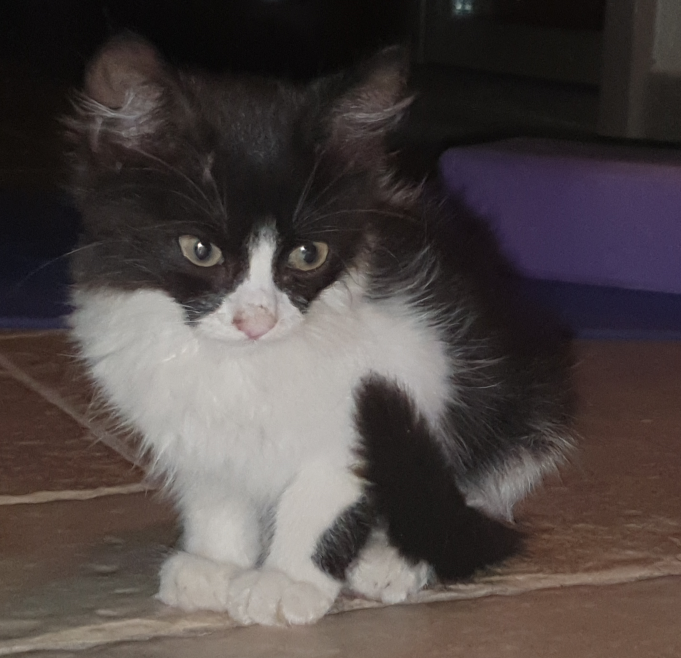
Batman would have been six years old this month – although I cannot say that with absolute certainty, because when I found him and his ginger brother, Minchin, they were abandoned kittens, living on the streets of a quiet little neighbourhood in Greece.
As you can see, Batman was a “tuxedo cat” with distinctive black and white markings, and a very pronounced black “mask” over his eyes, so the name Batman was an easy one to conjure.
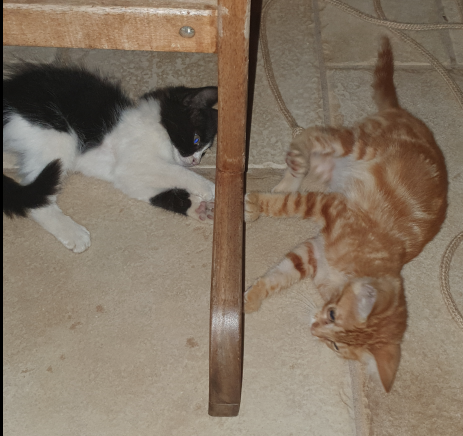
I estimated their age to be around ten or twelve weeks old at that point. As you can see they were both quite tiny!
If you’ve ever visited Greece you will know they have a serious problem with stray cats and dogs, in some regions you will find literally dozens of them running wild.
We had probably about 8 or 10 cats who would visit the villa daily, but seeing these two tiny kittens surviving together against the odds touched my heart.
I looked into the stray problem while I was there and saw the horrifying statistics that very few cats survive their first year in Greece. They are fed mainly by tourists during the peak summer months, but in winter, once the tourists go home, they are left to starve by locals.
While I had a cat and a dog already at that time, I was so moved by these two little survivors that I was compelled to see if there was some way I could adopt them and bring them home.
I found a local Greek charity that specialises in rescuing cats, getting them health-checked, vaccinated, and providing pet passports, and could then send them back to me in the UK.
Never have two kittens been more spoiled. When they arrived, I took a week off work to look after them – what I called my “caternity leave”.
I had a spare bedroom which I made as cat friendly as possible, to allow them to settle in without the stress of meeting my dog and other cat, Cocoa.
I spent hours and hours each day with them, playing with them and giving them all the attention they could handle. Which was a lot! While they were naturally a bit skittish given their early struggles on the streets of Greece, and then the disruption of being taken to a vet, then the sanctuary where they lived for about five or six weeks, before being bundled into a cat carrier and sent on a plane to meet me.
But within a day or two they both bonded with me and became very tactile and affectionate.
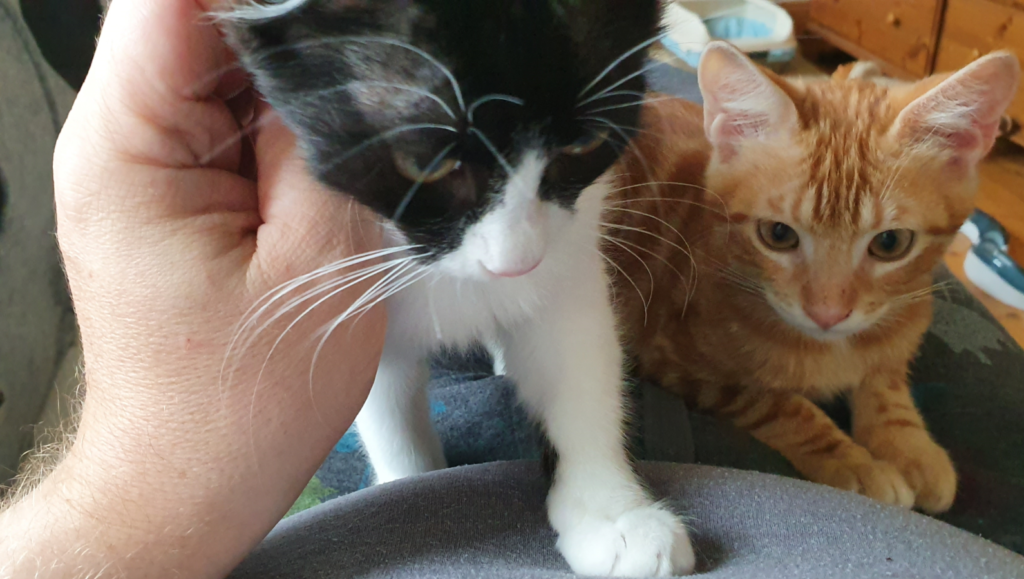
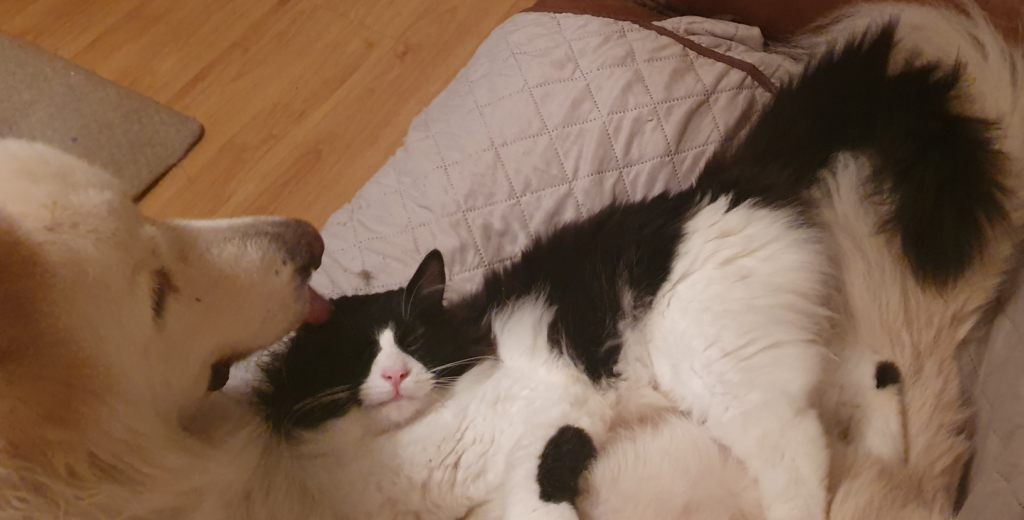
They settled in quickly, Batman especially forming a bond with my white German shepherd, Willow. She adopted them as if they were her own puppies.
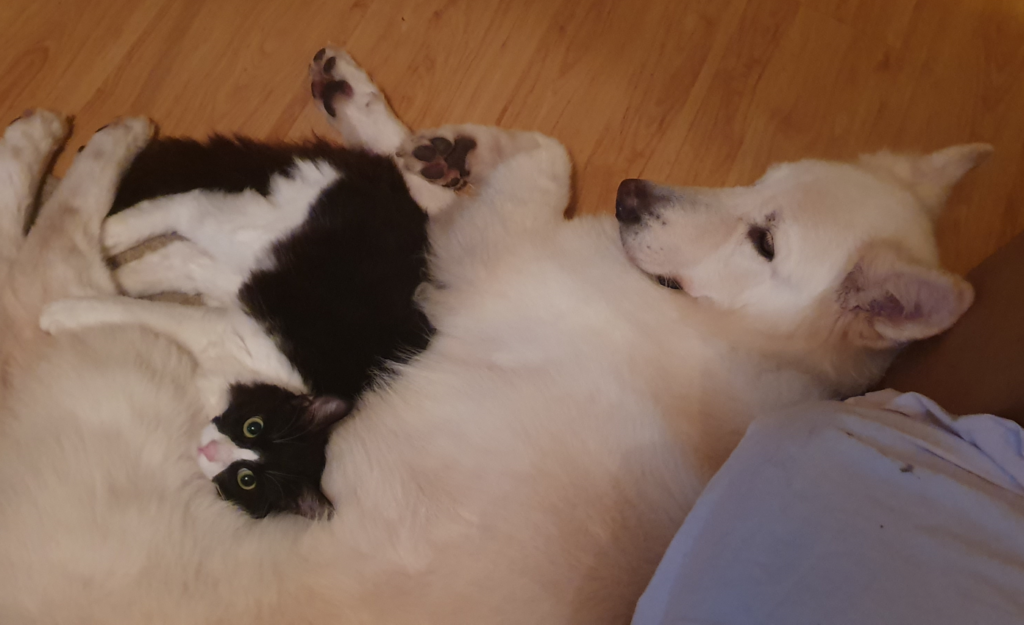
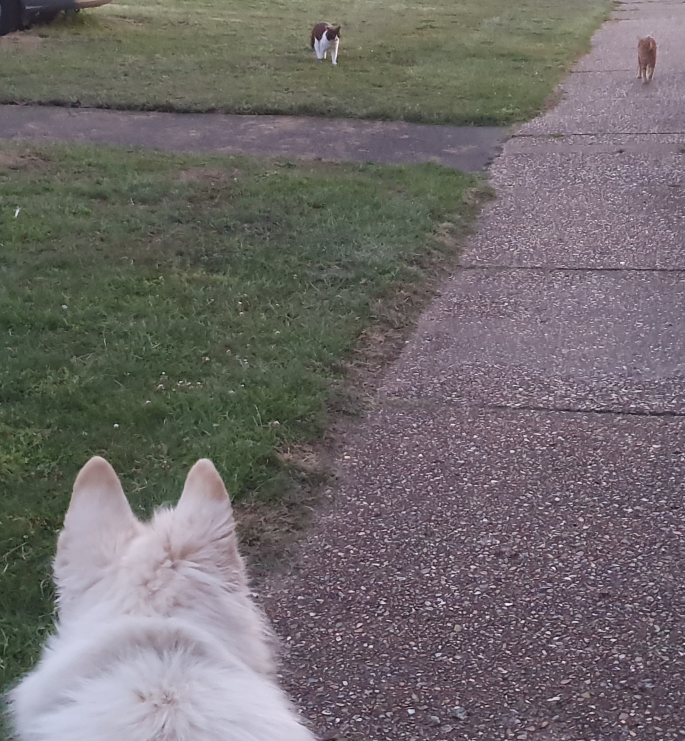
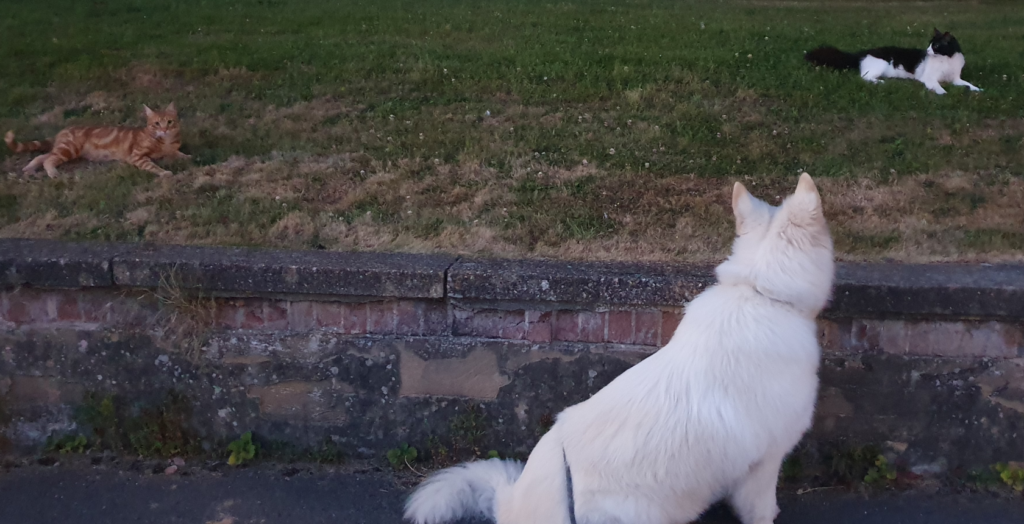
Strange as it sounds, they both used to come out on walks with Willow and I. At that time, I lived very close to a nature reserve, and they would just follow us and walk with us.
I have had many cats over the years, but none have felt as close to me or my heart as Batman. He was super affectionate to me. He would lick and nibble my fingers, but always very gently. And often he would greet me by licking my beard, as if I was just another fluffy animal in his extended family.
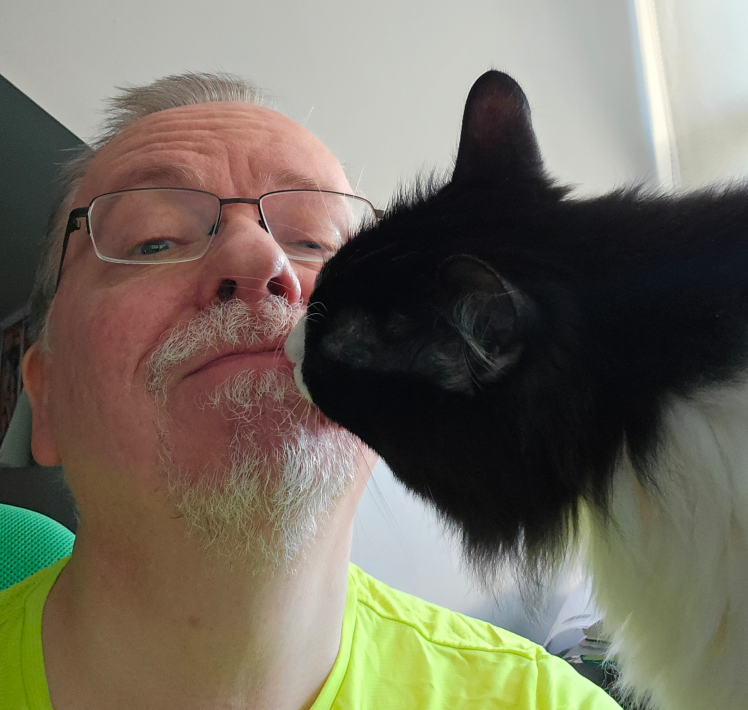
Most nights he would sleep with me, snuggled right up to me.
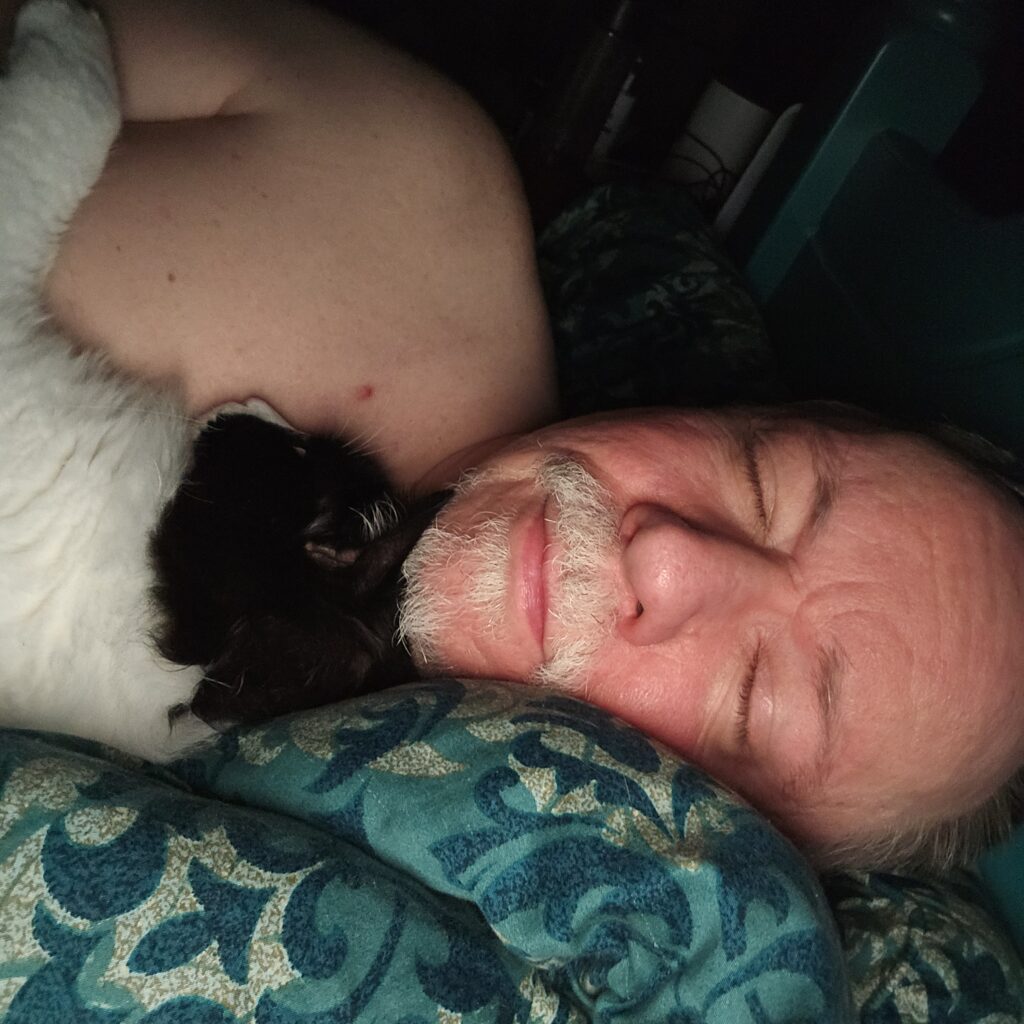
So it was in the context of this deeply bonded, mutually affectionate human/cat relationship that I got a call from my neighbour last Wednesday saying “I’ve hit your cat, Batman, with my car”.
For context, my neighbour has my phone number because she and her daughter have been my cat sitters on many occasions since I relocated here to Cambridgeshire about 18 months ago.
My initial thought was, “how much is this going to cost me?” As you know I am currently out of work due to redundancy and with little money for vet bills.
Little did I know just how high the cost would be.
When I stepped outside the back gate to the end of the quiet little cul de sac where my neighbour lives I was initially confused. I was expecting the incident to have occurred right outside their house in the parking spot where they charge their EV. Their car was not there.
Walking out a bit further, I was shocked to see quite a gathering. Not just my neighbour, but a bunch of other neighbours all standing around what appeared to be a blanket on the tarmac in the middle of the road.
Dumbstruck, I walked closer only to realise the blanket was covered in blood, and Batman’s instantly recognizable black and white fur was just poking out.
As I approached the scene the amount of blood involved suddenly hit me like a punch in the gut.
As you can imagine things are a bit of a blur. I remember yelling something like “What have you done!??” and “not my baby!” but I was in tears. Thick blood was flowing freely from underneath the blanket. My immediate thought was that Batman was dead – but then I saw one of his hind legs twitching.
One of the other neighbours that I don’t know was kneeling next to him. She was saying something about there being nothing a vet could do. And “you really don’t want to see him like this”.
My only thought was, if he was alive he needed to know I was there – that his person was there with him at the end. So I said I had to see him.
I don’t regret that request because it was the right thing to do but what I saw nearly broke me. I won’t even describe it here as it’s so horrific, but his head was crushed and there was no sign of life in his poor little broken face. The movement I’d seen was likely just a last spasm. I petted and talked to him but he did not respond.
The horror of what I saw that day, my sweet little baby, brutally crushed, will likely live with me for many years; it keeps coming back to my mind and keeps me awake at night. Seeing road kill is bad enough – but seeing your beloved cat like that is a totally different thing.
My neighbour offered to wrap him up in the blood-soaked blanket she had used and I numbly accepted. She covered his head and wrapped him as best she could. When she handed him to me, I turned and immediately saw, under another neighbour’s car, Minchin, Batman’s brother! He had been there the whole time, and likely witnessed the entire incident.
It’s funny the things you do when in shock. Clearly, I wasn’t thinking straight, and my first thought was that he needed to understand what had happened to his brother – and so I tried to get him to come out and see Batman, but he remained under the car.
I walked back home with the dead weight of my cat in my arms, crying uncontrollably at this stage.
I’ve never lost a pet to an accident before. Never had to deal with the crushed and broken body, and think about what his last moments must have been like. In the past when pets have been ill, I’ve been involved in the process from the outset, actively engaged with a vet trying to treat them, until ultimately having to make the decision to end their suffering. That path is never easy, but at least there is some illusion of control, of agency.
And when the end came, I was the one taking them to the vet- or, as in the case of my dog Willow, just a few years ago now, bringing a vet to the house so she was in familiar, comfortable surroundings. And I was of course, always holding them at the end, so they at least had the comfort of a familiar presence as they went peacefully to sleep for the last time.
There is a sense of peace that comes from knowing, deep down, that you did the best you could for them, and that you were with them all the way.
But this? Having my baby brutally taken from me in such a horrible way, without me there to help or comfort them, that’s been very hard to bear.
The neighbour who ran over my cat insisted that she was driving slowly, and this was corroborated by another neighbour who said she was a witness. Apparently there is footage from a security camera but for obvious reasons I do not want to see this.
She insisted that there was literally nothing she could do. He had just run straight out from behind a wall into the path of her car. At first I simply accepted that story although something didn’t feel right.
She had been with her young daughter, who as I mentioned had also been helping out with feeding my cats at times, and her daughter had comforted Batman after the accident happened, apparently, so at least he had some familiar voice/touch at the end.
Still, I stumbled through the practical steps of making final arrangements for Batman. Despite being out of work, I was keen to try and have him individually cremated, which is what I’ve done with previous pets who passed. My neighbour, after being pressed, was willing to send some money towards this which made it possible, and I drove him to the crematorium on Thursday afternoon.
I cried a lot over those first few days, quite understandably – at least to a pet lover! I know some people find it odd that we treat these little furry babies as if they were our own family, but that is literally what they are to me.
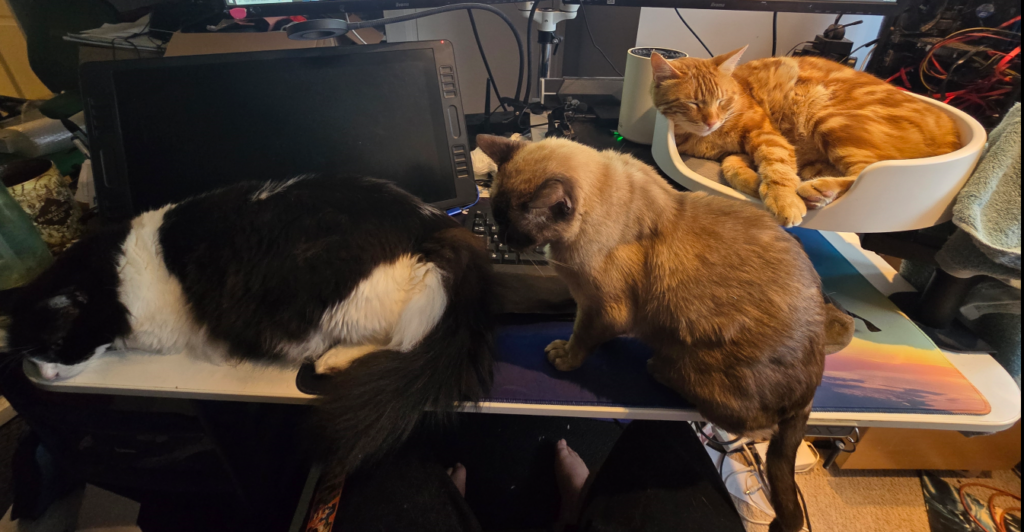
This is one of the last pictures I have of Batman, with his two brothers, Cocoa in the middle and Minchin on the cat bed in my home office. I got the cat bed because they often would disrupt my work by coming for attention…but of course there is only so much space for a cat bed, and when all three of them are craving attention it’s time to take a break from work, whether I like it or not!
How and Why?
Of course, as a loving cat parent, I really felt the need to understand how and why this could have happened. Something about the story just didn’t add up. Here are the facts that kept going through my mind, and which just didn’t make sense to me.
Cats have amazing hearing. And amazing survival instincts. And incredible reflexes – among the very fastest reflexes of almost any animal alive.
Batman in particular was very skittish around cars – he was rescued, along with his brother Minchin, from Greece. They were living near a villa that backed right onto the main coastal road, and it was clear he was bothered by the sound of cars. I can’t help wondering whether that is how he lost his mother. And for all I know, perhaps even other siblings.
When I brought them home to the quiet little cul-de-sac I lived in back then, he was always super alert around cars.
So how could he simply ignore his senses and run blindly into a car moving at low speed?
It took a couple of days to piece things together, but eventually it clicked.
My neighbour drives an electric vehicle. A big one. It’s a 2025 OMODA Noble E5, so an electric SUV, a solid 1.5 tons in weight. But despite that bulk, with no combustion engine, electric vehicles are virtually silent at low speeds. While in Europe they have been forced to introduce some kind of “low speed alerting” mechanism, this is not consistently applied, and often the alert sound is not something a cat might instantly recognize as a warning. I’ve often been there when my nieghbour arrives or leaves and I have never heard any kind of alert.
For a cat like Batman, raised near a major road in Greece, a car sounds like a combustion engine and is easily avoided.
With a silent EV he had no warning, and no chance. His life was snuffed out horribly because of a technical “enhancement”, and my neighbour’s choice to save a few pounds on petrol, perhaps while giving her the sense that she was doing her bit for the environment.
Initially, I had been quite forgiving of my neighbour – it did sound at first like it was an unavoidable accident, and she did pay £50 towards cremation costs.
But after I realised the cause was her silent electric SUV I sent her a simple message explaining this and just letting her know that this could happen again. She herself has two cats, and there are neighbours with young children on our street who could just as easily be caught out by a silent EV.
it’s really been plaguing me how this could have happened given the situation. Batman has always been very skittish of cars, ever since I found him and his siblings as kittens near a main road in Greece.
Given that this happened at such a slow speed, the only logical explanation is that it’s because it’s an electric car. Even though 2025 models like your OMODA are fitted by law with low-speed acoustic safety hums, those artificial, high-pitched sounds are notoriously flawed. They easily blend into background noise, get muffled by gravel, or get blocked entirely by things like a neighbour’s wall. To a cat’s survival instinct, it just doesn’t register as a multi-ton threat the way a traditional rumbling engine does.
Batman simply didn’t hear a vehicle coming, so he had zero warning before stepping out. I just wanted to share this because it’s a known, horrific loophole with modern EVs—at low speeds in a quiet cul-de-sac, they are still functionally silent to an animal or a young child playing out on the street. It’s just an awful situation for everyone, but I wanted you to be aware of how easily it can happen when a car doesn’t make a real engine sound.
I did not say it in a mean way, just being genuinely factual, but at that point she became very defensive, saying electric vehicles are increasingly popular, and that it’s just the price you pay for having outdoor cats!
She said she didn’t want to talk about it anymore. She was more concerned about the trauma that she and her daughter had “suffered”. It suddenly seemed like she was only willing to take responsibility for her actions when she could write it off as entirely accidental, something she had no control over whatsoever.
The Real-World Failure of EV Safety Mechanics
I say this really for the benefit of other EV drivers who are also pet lovers or owners. Please be aware: even if your car has a built-in low-speed “alert,” it is likely insufficient to warn an animal or a distracted pedestrian, especially a child.
While many drivers assume that newer models meet all safety checklists, the technology itself has a well-documented blind spot. Real-world data and safety studies show that these systems have fundamentally failed to completely close the safety gap, for several clear reasons:
- Incongruous Frequencies: The mandated sounds are rarely designed to sound like real car engines. Instead, they are usually high-pitched, futuristic electronic hums or whirs. To a human or an animal’s natural survival instincts, these synthetic sounds do not register as a vehicle or hazard that they might be familiar with avoiding; they simply blend into the ambient background noise of wind or air conditioning.
- Low Decibel Thresholds: Under current regulations, the minimum volume requirement for these hums at low speeds is only 56 decibels – which is quieter than a normal conversational voice. When an EV is creeping forward at a literal crawl, this faint sound is completely masked by environmental factors, such as the tire noise of rolling over gravel.
- Acoustic Dead Zones: High-frequency sounds are directional, meaning they are easily blocked or deflected by solid objects like brick walls or hedges. Unlike the deep, bass-heavy rumble of a traditional petrol or diesel engine – which vibrates through the ground and bends around corners – the high-pitched hum of an EV will not reach an animal or a child standing in a physical blind spot until the vehicle is directly upon them.
A Warning to Drivers
The statistics regarding quiet vehicles and low-speed maneuvers are a matter of public record. Studies have long shown that hybrid and electric vehicles are significantly more likely to be involved in collisions with pedestrians and animals during low-speed maneuvers – such as pulling away, turning, or reversing in residential zones – than traditional internal combustion engines.
If you drive an electric vehicle, please do not rely on your car’s artificial safety hum to act as a warning system. In a quiet cul-de-sac, at a slow speed, a quiet EV remains functionally silent and unrecognizable as a threat to a pet or a playing child.
The responsibility to check blind spots, look under the chassis, and assume that living things cannot hear you coming lies entirely with the person behind the wheel.
I share this not out of malice, but in the hope that understanding this technological loophole will force other drivers to be hyper-vigilant, preventing another family from experiencing a completely avoidable tragedy.
The aftermath
To say it’s been tough would be an understatement. To lose a pet at any time is hard, but, well, it’s hard to imagine a worse situation.
Both of my other cats have noticed the loss. Minchin is often walking around the house pining and whining. He has rarely been as affectionate as Batman, but has become quite clingy and cuddly.
Obviously, that has been a great comfort for me in these last few days, and I hope for him too.
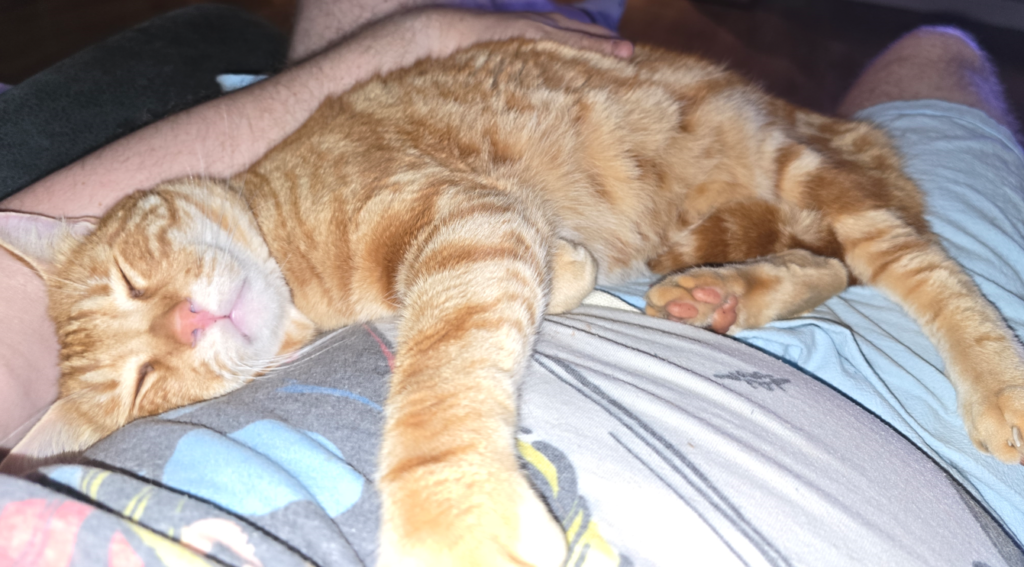
He is now often found in what was Batman’s favourite spot, by the patio door, perhaps where his scent is strongest.
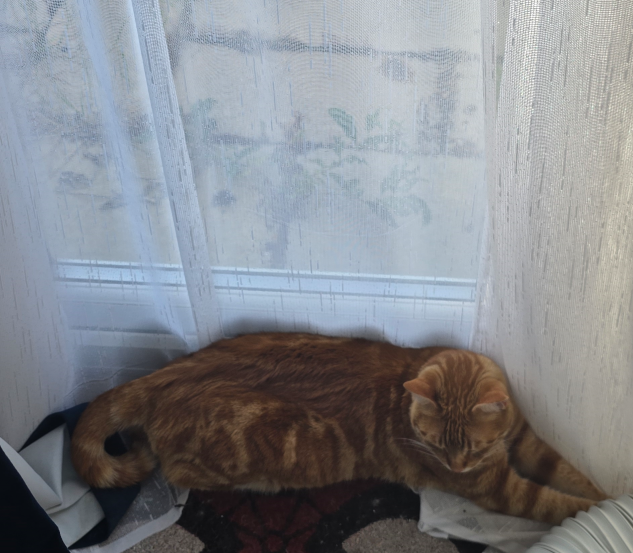
Cocoa has also been more likely to curl up in my lap. While he has often been a little outnumbered and occasionally bullied by my younger cats, who are both bigger than he, they would all mutually groom, which means they recognized each other as part of the pack.
We will all have to deal with this tragedy as best we can. Sadly, it is part of owning a pet. They rarely outlive us, and we are the ones left to cope with their passing.
RIP Batman, you truly were a very special cat, and I will never see another like you. I was very lucky to find you and I hope you felt the same about me. Hopefully, the 6 years you had here were a much better life than you would have faced in Greece. I miss your cuddles.