

In a previous post, we tore down the traditional food pyramid and put it in the trash, alongside the myth that there are “good carbs” and “bad carbs” for Diabetics (hint – they are all bad!).

It’s never good to merely critique established “wisdom” without being constructive and offering a better alternative, so here is my proposal for a new diabetic-friendly food pyramid!
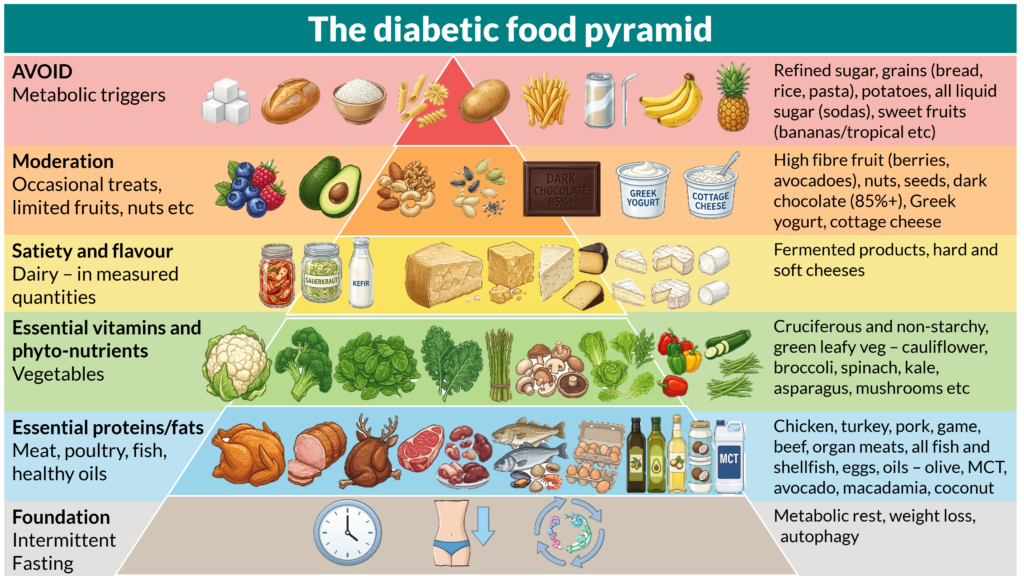
Let’s run through it layer by layer, starting at the bottom.
The foundation – intermittent fasting

My base or foundation layer supports the rest of the pyramid and is intermittent fasting.
Why so fundamental?
Fasting is the exact opposite of and therefore the natural antidote to Type 2 Diabetes!
For me, fasting is the philosophical starting point. In the simplest terms, the insulin regulation process that leads to Type 2 Diabetes is the fat storage process. The “trigger” for Type 2 diabetes is a breakdown in communication between insulin and your cells, usually caused by chronic energy overflow.
Insulin production is the regulatory mechanism for this excess blood sugar – when we have too much glucose in the blood, insulin is released to trigger the body to store the excess energy for later use. We all have a “set point” for how much energy (in the form of glucose) our bodies can tolerate before insulin cannot keep up.
Fasting is the inverse of that storage process. From an evolutionary standpoint, the reason we became very efficient at storing excess energy as body fat is so we could survive long periods of famine, which were common in our early development.
Fasting accelerates weight loss
Fasting is also my foundation for more pragmatic reasons. It’s a very powerful accelerator of weight loss. Weight loss occurs when there is a calorie deficit. Fasting is a very simple and effective way to achieve a calorie deficit. By reducing the window in which you eat, you can cut out one, two or even more meals in a day, thereby creating a significant calorie deficit.
In the past I lost a lot of weight using a 16:8 fasting schedule. This time around I was determined to achieve diabetic remission rapidly so picked a more aggressive fasting schedule, 3 x 36hrs. By not eating for three days a week I effectively reduced my calorie intake by around 1/5, creating a huge deficit.
But fasting works even better with a low carbohydrate or ketogenic diet. The two complement each other perfectly.
When you lower carbohydrate intake below around 30g of carbs per day, the body switches gears and starts the mechanism whereby your stored fat is converted back into fuel. This process is called ketosis. Fasting also uses this exact same process to keep you “fueled” even when you take on board no new fuel at all.
Alternative diet approaches that also reduce calories run into a problem that makes them less effective than keto / fasting. Even when calories are reduced, if carbohydrates remain moderate to high, your blood sugar level is constantly high, causing insulin to be released – and this effectively puts you in “fat storage mode”, not “fat burning mode”.
The human body cannot do both things at once, it is either “fat burning” or “fat storing”. If you are in fat storing mode, but you have a calorie deficit, the only way the body can deal with the deficit is to cannibalize muscle tissue.
When you are in ketosis / fasting your body naturally and easily uses body fat as it’s primary fuel.
“But we NEED to eat…don’t we?”
As long as we have stored body fat we can survive almost indefinitely via the “fat burning” process (with appropriate supplements). This has been demonstrated by many recorded, medically supervised extended fasts – most notably that of Angus Barbieri who fasted for an astounding 382 days, from June 1965 to June 1966, surviving on tea, coffee, sparkling water, vitamins, and yeast extract (Marmite here in the UK, which people dissolve in hot water – similar to using stock cubes or bone broth). Barbieri lost 276lbs of stored body fat in the process!
As we know, weight loss is one of the clinical recommendations for achieving diabetic remission and by leveraging the natural mechanisms of fasting we can lose weight rapidly.
While I certainly don’t recommend extended fasts like that of Angus Barbieri, or even the 36 hour fasts I use, shorter, intermittent fasts have been demonstrated to be just as effective. We all fast naturally overnight for between 8 and 10 hours, typically, sometimes longer. The key to successful intermittent fasting is to begin by extending this period.
If you typically finish your last meal at 9pm, then eat at 7am, this would be 10hrs of fasting. Simply extend your overnight fast gradually. Start by either eating your last meal an hour earlier or your breakfast an hour later for an 11 hour fast. Once this feels comfortable extend it by another hour, and another. Aim for at least 16 hrs in the first instance, effectively removing one meal entirely. This is excellent for weight loss.
If you can, I highly recommend pushing your fasting practice further and I’ll explain why in the next section.
The healing power of fasting
Intermittent fasting introduces metabolic rest. While you’re not putting more fuel into the system, your organs have nothing to do, and so have time to recover and repair from the damage done by diabetes.
In addition, longer fasts, above 16 hours, kick off a process in the body called autophagy. This is the body’s natural cellular repair mechanism. Perhaps counterintuitively, when you are fasting, your body works hard to make it more efficient by repairing and getting rid of dead cells. It actually makes perfect evolutionary sense – when hunger sets in, you need to be prepared to work harder to find food, so you need to be in the best possible condition.
In the context of diabetes, autophagy plays a key role in maintaining blood glucose homeostasis, particularly through the regulation of insulin secretion and sensitivity. Additionally, autophagy aids in preserving the survival and function of pancreatic beta cells by eliminating harmful proteins within these cells, which is vital for the prevention and treatment of diabetes. For more information see this article here.
Autophagy ramps up significantly when you fast between 18-24hrs so pushing your fasting has significant additional benefits.
So – in conclusion, fasting is our foundation, or our base, because it reverses the process that causes diabetes – runaway fat storage – while helping accelerate weight loss, and at the same time it helps balance the systems involved in regulating insulin.
It also clears the way for healthy eating habits as we’ll see in the subsequent layers of our pyramid.
The food pyramid layer 1 – essential protein and fats

The flip side of fasting is feeding! And of course this is absolutely vital since if you don’t feed yourself, you’ll (eventually!) fade away and we don’t want that!
The basis of what you eat should cover the essentials. Amino acids and essential fats are literally the building blocks of the human body. They are also your primary sources of fuel through both gluconeogenesis and ketosis. These two processes take consumed or stored protein and fat and convert them to usable energy.
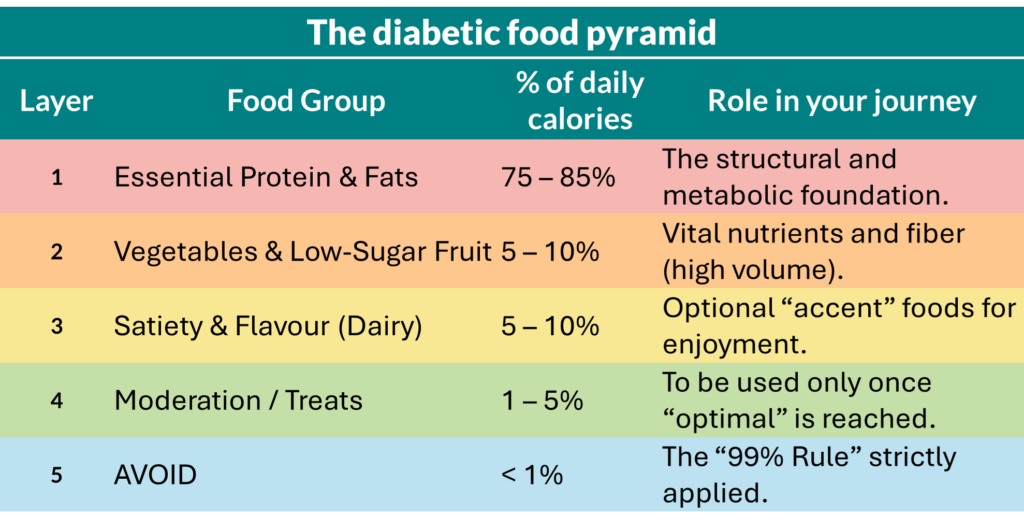
This layer should represent as much as 75-80% of your daily calorie intake. Yes, that sounds a lot, but these are the essential building blocks. These foods are naturally very satisfying so will help you feeling full through the day.
Layer 2 – eat your greens – nutrients and fibre

The next layer of our pyramid is vegetables and fruit. But this is not a catch all.
Vegetables on the whole are nutritious, fibrous and relatively low in starch, which releases slowly, however, there are key exceptions which should be avoided by diabetics.
As a general rule, vegetables that grow above ground are best, while those that grow below ground are typically more starchy and should be completely avoided. For example, potatoes, sweet potatoes, squash etc offer little additional nutritonal value beyond empty carbohydrates.
Fruit is generally something to avoid due to the high fructose content, which is fundamentally equivalent to glucose.. There are a few key exceptions. Avocados are, of course, a fruit, and arguably a super food. Berries are are also highly nutritious but relatively low in sugar so can be eaten in moderation.
Just a quick note – while botanically classified as berries, bananas are high-sugar metabolic triggers and must be avoided. Also, another bit of fruit genealogy trivia, strawberries are in fact not classed as a berry but are permitted in moderation.
This layer should represent around 5-10% of your daily calorie intake. Most of these foods are relatively low in calories so this still represents a lot of volume, which helps keep you full.
Layer 3 – Satiety and flavour (dairy)
Dairy takes an interesting place in our pyramid, since it includes both protein and fats. But also can provide some carbohydrates (e.g. lactose as found in milk, yogurt etc).
Dairy is not a dietary essential, indeed there are many who are lactose intolerant and cannot tolerate dairy well at all, but for most of us, it can help provide flavour and satiety to support your journey.
Dairy is also not an all-you-can-eat buffet. As mentioned, lactose is essentially a sugar, and some dairy products have more than others. As a rule fermented dairy products like hard cheeses are much better than non-fermented products like milk and cottage cheese.
Also avoid “low fat” and “skimmed” versions of any dairy products – e.g. Greek yogurt. These versions have more lactose and therefore more carbs.
And as we have discussed elsewhere, consuming anything as liquid, such as milk or yogurt, rather than as a solid, makes the carbs much more readily available so will spike blood sugar more rapidly.
Cottage cheese and Greek yogurt are in my “moderation” list rather than their natural home in this category. Cottage cheese is actually not fermented, and effectively in a liquid form, and so Dr Richard Bernstein refers to it as liquid sugar, and advises avoidance.
Dairy should ideally represent no more than 5-10% of your daily calorie intake. It’s a flavour enhancer and there to help with satiety. It’s absolutely not essential so less or none is fine!
Layer 4 – Moderation (occasional treats once your diabetes is under control)

In this layer we have foods which have many potential nutritional benefits, but at the same time, can be very high in calories and/or carbohydrates and therefore may hamper your initial weight loss goals, or derail your attempts to remain in ketosis.
This list includes even superfoods like avocados due to their relatively high carb count. Berries also feature on this list, along with nuts and seeds. Dark chocolate should also be treated carefully, as well as Greek yogurt and cottage cheese. Personally I consider cottage cheese to be “forbidden” but only because I despise it! 🤢
This layer should therefore be considered as an optional additional layer to include only after you get your diabetes under control.
What does “under control” mean?
Dr Richard Bernstein, in his seminal book “The Diabetes Solution” argues that diabetics are entitled to exactly the same healthy blood sugar numbers as non diabetics. So your target should be a normal, optimal HbA1c – which would mean in the range 22-27 mmol/mol (4.2-4.6%). This may come as a surpise to many of you who’s medical team are advising you to aim for 48 mmol/mol (6.5%)!
Bernstein provides stark evidence in his book that glucose levels this high will still cause significant damage which over time will still lead to diabetic complications. Getting down to the optimal level is the only way to prevent further damage and diabetic complications.
Further, we have to remember that the HbA1c blood test, while valuable, is nothing more than an average taken over a three month period. It does NOT show the daily spikes you may be experiencing. He again advocates for an optimal blood sugar level throughout the day, which would be betwen 80-90.
Once again, the medical profession often advises patients that 120 or even 140 is “fine”, but Bernstein has demonstrated that even at 100, blood sugar is high enough to cause more of the damage that leads to diabetic complications.
If any of your “treats” or “moderate” foods are taking you above 90 then these really should not be part of your regular eating plan, and should be pushed down to the fifth and final layer of the pyramid – foods to avoid.
Otherwise, allowing between 1-5% of these foods should be fine.
Layer 5 – AVOID! Metabolic triggers that send you back to diabetic hell!

You will, of course, note that the pyramid has another layer at the pinnacle. This is what we should be eating the least of. I’d like to say “none of” but I know we’re all human, and occasionally for whatever reason “life gets in the way” sometimes. We may find ourselves at a social event where it’s just not practical/polite to bring your own snacks. For whatever reason, we shouldn’t beat ourselves up if we do eat from this layer, but if we’re doing so as a “treat” we’ve already fallen back into the trap that made us diabetic.
These foods are very high in sugar and, therefore, naturally addictive. They can also trigger memories of “comfort eating,” which can be psychologically addictive.
If we want optimum health, as diabetics, we should actively avoid everything on this layer as far as humanly possible.
Sadly, we often see this being taught to diabetics as “foods to eat in moderation”! This is just plain wrong!
These are all foods that will make your diabetes worse, leading to high blood sugar, inflammation, cardiovascular damage, hypertension, diabetic neuropathy, and retinopathy, and many more potential complications besides.
Sadly, this black list isn’t just “obviously evil” foods – the ultraprocessed foods and fast food junk that we should all know are metabolic triggers for diabetics.
This list includes almost all starches and grains – rice, bread, pasta, etc., as well as the fruits and vegetables high in sugar.
Fruits should be completely banned from our diet apart from avocadoes and berries, which should only be consumed in moderation.
As mentioned earlier, starchy vegetables, typically those that grow underground, are much higher in sugar and should be avoided – that includes potatoes, sweet potatoes, turnips, parsnips, and celeriac. While carrots grow underground and are relatively high in sugar, and are excluded by some, I choose to put these into my “moderation” category due to their other nutritional benefits.
The 99% rule
You may have heard people talk about the “80/20 rule” for dieting. 80% of what you eat should be healthy and nutritious and it’s fine for 20% to be “play food”. Ie whatever you want. I can tell you that I used to subscribe to this rule myself, and it’s a large part of what made me diabetic. The 80/20 rule is NOT appropriate for diabetics. Getting 20% of your calories from this group of foods would be absolutely disastrous.
I propose a new rule for diabetics, let’s call it the “99% rule”.
99% of what you eat should be from our four primary food group layers at the proportions listed (and presented at the end of this chapter in summary form), with 1% – a very occasional treat – coming from the forbidden list.
The 99/1 rule allows for things like the occasional birthday and holidays, without you feeling like you are risking a full return to your old habits, and without you incurring significant damage during the inevitable glucose spikes.
What does that equate to in real terms? I would argue that anything more than a single monthly slip into the forbidden list is risking a relapse. More than that, and it’s starting to risk becoming a habit.
Of course, everyone is different. My other advice about this would be to use a CGM (Continuous Glucose Monitor) to see what kind of impact your typical slips have on your blood sugar – for those that are genuinely high impact (taking you above 100), I’d say stick to even less than once a month. Even then, if your treats are taking you to 140 or above, I would say these should be reserved for annual one-off occasions. Perhaps Christmas dinner or Thanksgiving. But not both.
The good news is that many of these special occasions can easily be catered for while sticking to our food pyramid – simply avoid the starches, and fill up on proteins, fats, and plenty of vegetables.
If you find some of your favourite “forbidden foods” don’t spike your glucose too badly – let’s say taking you to 100 maximum – then once a month is probably reasonable.
Summary
Let’s review the percentages of your daily calorie intake per layer again. You may have noticed, while going through the above, that if you stick to the top end of each calorie range, you’d end up over 100%! The math ain’t mathing! 😆
You need to think of these percentages as a sliding scale for your daily ‘metabolic budget.’ If you choose to enjoy the maximum range of dairy or treats, you MUST naturally dial back your protein and fat intake to stay within your total caloric goal. The foundation remains fixed, but the upper layers are a zero-sum game.
Also, we all have to accept that not all Type 2 diabetics are created equal. We all suffer from a degree of insulin sensitivity, some more than others. For some, even very small amounts of carbs as found in e.g., avocados and Greek yogurt may be sufficient to take your blood sugar over 90. Be sensible. If you want to eliminate the risk of blood sugar spikes, use a blood sugar monitor to see how your body responds to those higher-carb choices and adjust accordingly.
Likewise, if there are some of your favourite foods that might live in my “avoid” category, but you have verified that you can keep under 90 while eating them in moderation you can feel free to move them into your personal “moderation” layer. Just remember that you should periodically check your post-prandial blood sugar when eating these treats just to ensure that there hasn’t been any increase in your insulin sensitivity that warrants dialling them down, or even pushing them back to the “avoid” layer completely.
The aim of this pyramid is long term metabolic health – full diabetic remission with no risk of spikes that will lead to complications.
Some may read this and say I’m being a “killjoy” and that this is “extreme” and not “sustainable”.
All I will say to you is that I’ve had diabetic complications (chronic hypertension and severe neuropathy symptoms, along with early-stage retinopathy symptoms. And I can tell you that those things ARE extreme. Those things are a total “killjoy”. Those things are NOT SUSTAINABLE.
My opinion is that you will really want to avoid those things at ANY COST. And this may be the cost.
I, too, used to think this kind of way of eating was unsustainable, but all it took was 18 hours of persistent neuropathy symptoms to change my mind permanently.
And I don’t agree that these things “kill your joy”. As I’ve discussed elsewhere at length, the foods we love often don’t love us as diabetics. They are not “comfort foods,” they are toxic addictions. Removing toxic addictions from our lives should be a source of genuine joy and pleasure for all of us, and I can tell you that I feel so much happier now I’ve put them behind me.
If this is the price of long-term health and happiness, then it’s a price I, for one, am more than willing to pay.
Leave a Reply