• This week started well, then took a weird side turn.

    The beginning of the week started well, as I discussed in an earlier post.

    In the background, as some of you may recall, I was made redundant a few weeks back. I’m still kind of in a weird post-redundancy announcement limbo where, effectively, I’m still under contract, but was also told to look for other roles within the company’s careers portal that I might migrate to. Unemployment is still looming, and I’m told not to actually do any work. Nobody has even asked me for a handover.

    At the same time, there are some “negotiations” about my departure that are ongoing, and which, for contractual reasons, I am legally prohibited from discussing in detail.

    All I can say is that I finally got the response back from HR on Wednesday that “finalised” these negotiations, and not in a good way, and put paid to any doubts about finding another role within the company. It was frankly a gut-punch.

    As usual for a Wednesday, I was already fasting, about 12 hours in. So there may have been some natural fasting brain fog. But the anxiety that kicked in after my gut punch just turned the volume on that white noise up to eleven.

    In biological terms, cortisol – the stress hormone – put me into what’s called an Amygdala Hijack, where my primitive lizard brain is saying “fight or flight!” and drowning out the higher functions of the prefrontal cortex.

    There were a couple of practical things I needed to do that day, not least of which was speaking to my lawyer again.

    No doubt all of that combined with the strange vagueness about what day of the week it is that comes with not having regular job responsibilities. What happened on Wednesday afternoon was that I got ready for my run and headed off as normal.

    Those of you who pay sharp attention will have already spotted the deliberate mistake. I don’t run on Wednesdays. I swim on Wednesdays! Yesterday, Tuesday, was my running day and I’d already had a run.

    Not only did I have a run, but it was such a good run I literally blogged about it that day! It was a milestone of a run!

    It wasn’t until I finished my warm-up – just a 5-minute walk – that I remembered it’s Wednesday!

    At that point I had a simple choice, either come home, get changed again out of my run gear and then later change yet again into my swim gear.

    So I thought – what the heck, I’m here now – let’s just run!

    And so I did – just the easy version of my current running program – 7 x 2 mins running with 1 mins rest. My legs were a bit heavy (no great surprise) but, I surprised myself and managed it ok.

    Afterwards, I got home, a bit hot and sweaty, and looked at the clock. It was literally bang on the time that I’d get ready for my usual Wednesday evening swim. And I do love to swim. There was still time…

    Any sensible person would have just called it a day, had a shower, and chilled for the evening. There was nothing stopping me from swapping my days around for a change, running on Wednesday, swimming on Thursday!

    But I think my anxious brain was still just on autopilot, so I did the unthinkable, got changed into my swim gear and off I went to the pool!

    I’m not sure what I was expecting. I figured I’d be a little fatigued, but the reality was far worse. I did my first warm-up lap (one length breaststroke, one length of balance drills for front crawl), then started my usual set, which should have been 250m freestyle. That would be ten lengths of the pool.

    But I got to the end of the fourth length and I was done. My arms felt like lead! I had no strength at all. Basically, the run had burnt out my glycogen stores, and despite being very “fat adapted,” the internal processes that provide energy from stored fat just couldn’t keep up with the high-intensity demand of the stroke anymore.

    I guess this was a combination of factors – I was at that stage about 18 hours into a 36 hour fast, and my earlier stress would have also taken its toll. It really should be no surprise that I ran out of steam

    I made the most of it. I worked on some specific swim drills and skills. Usually I swim freestyle with bilateral breathing. What that means, for those non-swimmers, is that I breathe on each side, with a three-stroke pattern. So – I breathe as one arm recovers after a stroke, using my natural rotation to bring my head up just far enough to get some air, then stroke-stroke-stroke and breathe on the other side.

    Many people who swim breathe on one side only, so it’s more like stroke-stroke-breathe. The extra stroke keeps you streamlined for longer and reduces drag. The regular “unilateral” breathing often leads to muscular imbalances and potential injuries since you’re always breathing on one side only.

    What I focused on that night was extending my bilateral breathing to a five-stroke pattern. Breathe, then stroke-stroke-stroke-stroke-stroke and breathe on the other side, repeat another five strokes and breathe on the opposite side again.

    It took me a little trial and error, but I got into the swing of it eventually. Obviously, breathing less makes swimming more challenging from a cardiovascular perspective, which fits perfectly. I was not really able to swim more than one lap, two lengths of the pool at a time (it’s a 25 meter pool, so 50 meters for each lap).

    Because I could only swim slowly and steadily, it was also a great opportunity to really focus on my stroke mechanics for those two lengths.

    My swim watch seemed to be as confused as I was on Wednesday, so didn’t track exactly how many lengths I did, but since I was forced to rest after every 50 meters, I imagine it was only maybe 10-12 maximum rather than my usual 20-30 lengths.

    Still, I made the most of it – extending my bilateral breathing is something I’ve been meaning to try for some time. Incorporating sections of this type of swimming is good for cardiovascular fitness, but also, in principle, should help my speed since raising the head to breathe is one of the natural “brakes” you apply when swimming.

    The less you breathe, the quicker you swim. For context, 50m elite sprint swimmers will swim an entire length without taking a breath, just on the oxygen in their lungs at the start, in order to completely minimize the drag from breathing.

    Anyway, as I say, it was a weird day, but I made the most of it.

    And in hindsight, weird as it was, it was a huge win. Why? Because my default reaction to my stress was to take more exercise! While this was not ideal, when I think back to even six months ago, my stress reaction would have been either to order takeout or maybe even have a drink. Or both!

    It was completely unconscious, but I would rather have gone out for another swim than wallow in anxiety and misery!

    And after arriving at the pool and realising I was depleted with leaden arms, I could have just gotten out of the pool and come home. Instead, I made the best out of a bad situation and focused on some valuable swimming skills.

    All in all, I feel very proud of myself!

    And just to add a more upbeat note – I had a job interview on Friday that was incredibly positive, with a company that I feel is genuinely a great fit for my skills and experience. While I don’t want to count my chickens just yet, it really takes a load off! 😊


    , , , , , , ,

  • Swimming and running strong!

    ·

    I finished my first 36-hour fast on Monday and had a good swim in the evening. I was aiming for 2 x 500m, 1x 250m, but was feeling good, so I added an extra short set of 150m for a total of 1.4km. I could have pushed out another 100m for the full mile, but I ran slightly short on time, and my shoulder was starting to twinge slightly anyway, so I was very happy with 1.4km.

    I then weighed in on Tuesday morning to find I’d put on 0.6lbs for no obvious reason. Just the machine settling, I guess. As we’ve discussed before, as fat cells empty they often fill up with water, since the body wants to hold onto the cell as long as possible in case it’s needed for storage. It’s very efficient, but just means weight loss is never a predictable, linear curve. At some point, maybe after my next fast, there will be a sudden “whoosh” of weight loss as the cells are left with no choice but to submit; they give up their water and let go to be excreted.

    Later, I went out for my usual run, again pushing for 6 sets of 2.5 min running, 1 minute walking. This is now maybe my fourth or fifth run on this schedule, having alternated for a while now between this and the shorter runs (7 sets at 2 min run/1 min walk).

    While the warm-up set felt a bit sluggish, and my legs were heavy, once I warmed up, the engine was running smoothly, and I felt very strong through the rest of the sets. Normally, by the last set, I’m glancing at my watch by the last minute or so looking for it to be over, but today was the first day that I didn’t look at my watch all, I really felt strong throughout the last 2.5 minutes and was pleasantly surprised when the alarm vibrated to tell me the final set was over!

    This is a huge milestone for me from a run perspective, it’s felt like a real chore pushing my running just this little bit further, and finally I think I’ve cracked it!


    , , , , , , ,

  • Diabetics are being sold a lie. It’s a lie about “good” carbs and “bad” carbs. We’re told that, if we just switch from white rice to black rice, or from white bread to “multigrain diabetic bread,” we’ve solved the problem.

    But for those of us fighting to save our eyesight from retinopathy or our nerves from neuropathy, this isn’t just a white lie – it’s a dangerous distraction.

    The biological truth: there is no “essential carb”

    In the world of nutrition, there are essential fatty acids (fats) and essential amino acids (proteins). Do you know what there isn’t? An essential carbohydrate.

    Your body is a miracle of evolution. Like all mammals, our ancestors survived for millions of years by storing fat and living off it during lean times. The carbohydrates that have become a ‘staple’ of the modern diet simply did not exist back then—no industrial rice, no processed oats, no bread, no pasta.

    Even if our ancestors occasionally found a wild tuber, it wasn’t a modern potato. Most tubers were members of the deadly nightshade family – bitter to eat, and literally poisonous unless rendered edible by fire. They were a food of last resort, a survival tactic for when the hunt failed, not a foundational part of our biology.

    The biggest ‘sugar hit’ our ancestors would have found was the occasional seasonal fruit or – after risking a swarm of bees – some wild honey.

    Instead, we survived by burning our own body fat for fuel. Through a process called gluconeogenesis, your liver creates the exact amount of glucose your brain and red blood cells need from proteins and fats. You don’t need a single gram of external carbohydrates – not one grain of rice or slice of bread – to survive or thrive. We aren’t designed to be fueled by a constant stream of sugar; we are designed to be fat-burning machines.

    It’s actually why we store fat so well! We evolved that way as a survival mechanism!

    The “better” trap

    Manufacturers love to use words like “integral,” “cracked,” and “whole.” They want you to think their product is a save haven for diabetics. And sure, black rice is objectively better than a chemical-laden “diabetic” candy bar made of polydextrose and erythritol. A slice of sprouted-grain bread is better than a donut.

    But “better” is a relative term.

    • If you’re at the bottom of a hole, a slightly shorter ladder is “better,” but you’re still stuck in the hole.
    • If your daily limit is 25g of carbs to keep your blood sugar flat, a “healthy” serving of black rice (34g of carbs!) still bankrupts your budget and spikes your insulin.

    The glycemic smoke screen

    The “healthy carb” industry relies on the Glycemic Index (GI). They tell you these carbs digest more slowly. That might be true, but for a diabetic, a slow-burning fire still burns the house down. A “slow” spike is still a spike that causes oxidative stress and damage to your microvasculature, leading to hypertension and nerve damage.

    When we eat these “healthy” grains, we are still feeding the same addiction. We are still telling our bodies to rely on glucose instead of burning our own fat for fuel, the way we did for millions of years.

    The devil is in the details, but what underlies the design?

    The devil is always in the details. When you look at the label of that “diabetic-friendly” bread and see 24g of carbs for two slices, the “detail” is the cracked wheat on top, but the “design” is a cleverly marketed starch-delivery system that keeps you dependent.

    We have to stop asking, “Is this carb better than that one?” and start asking, “Does this food move me toward healing or toward more medication?”

    If you want to achieve lasting remission, you need to fundamentally question your relationship with carbohydrates and the myths you’ve been raised with.

    The final betrayal: tearing down the food pyramid

    One of the key reasons for this misguided belief in the power of carbs is the traditional “Food Pyramid” that most of us were raised with is a lie. It is the cornerstone of the addiction that breaks us.

    Think back to that colorful triangle from school. It told us – with absolute authority – that the “base” of our survival should be 6 to 11 servings of bread, cereal, rice, and pasta every single day. We were taught to build our lives on a foundation of starch. We were told to fear the very proteins and fats that human beings thrived on for millennia.

    The pyramid – not a map to health but a blueprint for metabolic disaster.

    It took a species designed for strength and resilience and turned us into glucose-dependent addicts. It told us to build our houses on a foundation of sand – specifically, the kind of sand that turns into sugar the second it hits our bloodstream.

    For a diabetic, following that pyramid is like trying to put out a fire with gasoline.

    The foundation of a damaging lie: who built the pyramid?

    To truly walk away from the “Healthy Carb” myth, we have to understand where it came from. Many seem to think the food pyramid came from on high on stone tablets. Or at least that it was designed by doctors to save our lives. The truth is much more cynical.

    It was born from a budget, not a lab.

    The very first version of the traditional food pyramid was created in Sweden in 1974. It wasn’t a health guide – it was a frugality guide. The goal was to show people how to fill their bellies on a budget during a time of high food prices. Bread and pasta were at the bottom because they were cheap, not because they were healthy.

    The American “dream”

    When the US version was being developed in the 1980s, the lead nutritionist, Luise Light, actually designed a version with fruits and vegetables at the base. She recommended only 2–3 servings of grains a day.

    But the USDA – whose job was and is to sell American crops- stepped in. They overrode the scientists and jacked the grain requirement up to a massive 6–11 servings a day.

    Luise Light famously warned that this change would trigger an obesity and diabetes epidemic. She was ignored. Industry profits won; our health lost.

    Rebranded animal feed

    You’ve heard the term “cereal” your whole life, but at the turn of the last century, these grains were primarily used as animal feed. Industrial milling created a massive surplus of grain byproducts, so the industry got creative. They used the same machines that made “kibble” for livestock to extrude “flakes” for humans. They rebranded low-cost animal filler as a “scientific” breakfast, and we’ve been eating like prize-winning cattle ever since.

    The Verdict

    The Food Pyramid was never a medical prescription. It was a sales brochure for the grain industry.

    For a diabetic, following the Pyramid isn’t “balanced eating” – it’s participating in a 40-year-old marketing campaign that has failed us. It’s time to stop building our health on a foundation of rebranded animal feed.

    Trash

    It is time to take that food pyramid and throw it into the trash can of history, right alongside other “expert” advice like smoking for relaxation or using leeches to balance the humors.

    The new “foundation” doesn’t have a base of grains. It doesn’t have “healthy” black rice or “diabetic” bread holding it up.

    • The base should be real, whole proteins and healthy fats. Eggs, cheese, grass-fed meats, and the nutrient-dense vegetables are what keep blood sugar flat and support metabolic health.
    • The peak of that pyramid, for me, is the ultimate freedom: Fasting. The realization that I don’t need to be constantly “refueled” by a starch-delivery system. That taking a break from eating – giving our organs a rest and time to recuperate – is just as important to our metabolic health as what we eat.

    Once you see the blueprint for what it is – a design for dependency – you can finally stop building a metabolic house of cards and start building your own health, on a stronger foundation. Whole foods, not whole grains. Essential nutrients, not marketing bullshit.


    , ,

  • So I had another blip last week that paused my weight loss. Actually, I put on 2.3lbs. This was a result of a trip to Newcastle to see my partner, as I discussed in my previous post, “Making Allowances”, where I allowed myself Chinese food. And enjoyed it! Since I’ve now blown past my HbA1c target, I feel more relaxed about my diabetes. And while I still need to lose weight to get my blood pressure fully under control, it’s good to reward yourself for great results!

    Chinese food is one of my favourite things, and it’s always been an occasional treat, so not something I feel will risk my long-term goals.

    That said, usually, after a blip, I’d be straight back on track on the Monday after a weekend away, typically starting a 36hr fast overnight. But I was driving back from Newcastle on the Monday afternoon, which is a 3.5hr trip in the car, and I was struggling a bit with my energy levels.

    So I decided to break my fast. I had brought some pork crackling and cheese with me as well as a Keto Hana keto bar as snacks (always thinking ahead!), and therefore I could break my fast safely and within my eating plan.

    I’d managed around 14 hrs fasting, which isn’t terrible.

    I then went out for a swim on Monday evening and managed 1.25km – also increasing my sets again to 2 x 500m, 1 x 250m.

    Tuesday, I was out for a run, and pushed my walk/run intervals from 2 mins run / 1 min walk to 2.5 mins run / 1 min walk. As I’ve said before, it’s really important at my age and weight to gradually increase the workload when running. My cardiovascular system is doing great, as I can see from my swimming, but it’s completely different when running, which is load-bearing. It’s really my tendons and ligaments that I need to think about, and they take time to strengthen.

    Tuesday night I started another fast, fully intending to do 36hrs again – but Wednesday after my swim I felt really hungry. I often go straight from the pool to Tesco to get any shopping in, and I just had a mad craving for hummus! And I had recently bought some more of these Monarch Crackers, which are a great keto snack. They are literally made out of pure cheese, and just taste like very cheesy crackers, so I thought they’d go really well with some hummus. And they did! 😋

    So yes, I broke my fast after 22 hours, still a great fast! I must admit this is the first time I’ve had any real food cravings since starting my program back in December. And I guess, given where I’m at with my HbA1c, I feel more inclined to allow myself treats when I crave them. I know from previous experience that feeling like I “can’t have something” is one of the reasons I’ve eventually fallen off programs entirely, and I’m determined not to let that happen this time.

    My swim on Wednesday was a recovery swim after pushing it on Monday, so I was back to just 4 x 250m.

    Then Thursday, I was back to running, and again I backed down to 7 sets of 2 minutes run / 1 min walk as my calves and hips were still feeling tight. I definitely found it heavy going, which is why it’s so important to listen to your body and take it easy on yourself.

    Friday I swam again – another 2 x 500, 1 x 250m, and then today, Saturday, I was back to running, and again managed 6 sets of 2.5mins run / 1 min walk. I definitely felt a bit stronger running today.

    Thursday I also checked my blood pressure – first thing in the morning, before my run – and the results were pretty good – an average of 121/84 with a 65bpm heart rate.

    I also started another fast on Thursday and managed my first 36hr fast of the week through Friday until this morning! 😊

    And great news – I lost that 2.3lbs and another 1lb on top for good measure, bringing me down now to 15 St 11.8 lbs (221.8 lbs / 100.8 kg). I’m soooo close to getting through the 100kg barrier, which is a huge milestone!

    That’s a total of 36.1 lbs (16.4kg) lost since I started in December, and a grand total of 43.7lbs (19.9kg) since diagnosis. That’s 16.4% of my starting body weight I’ve now dropped!

    Here’s my updated status tracker for the more visually minded!

    I’m now at 51% of my target overall weight loss – 43.7 lbs / 19.8 kg, with 41.8 lbs / 19 kg to go before I get to 12st 12lbs (180lb/81.6kg)


    , , , , , , , , , ,

  • Making allowances

    ·

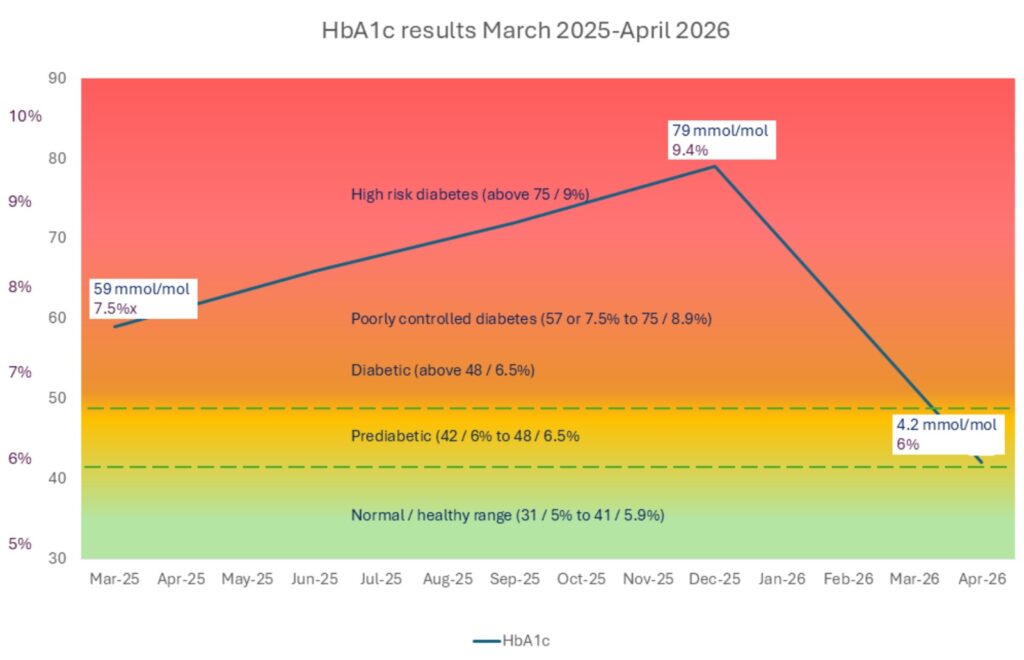
    Now that I’ve breezed through my blood sugar target – hitting 42 mmol/mol (6%) at the beginning of April – I’m beginning to relax a little as far as blood sugar goes.

    Hitting 42 mmol/mol (6%) in just 100 days puts me on a clear downward trajectory, averaging about 0.37mmol/mol or 0.034% per day.

    Graph showing HbA1c blood sugar test results over a period of approximately one year months, starting at 59mmol/mol in April 2025, rising to 79 mmol/mol in December 2025 and then sharply declining to 42mmol/mol in March 2026

    Purely by estimation, based on my progress to date, since it’s now two weeks from my last HbA1c test, I should be somewhere around 36 mmol/mol or 5.46% today, which is way beyond where I’d expected to be at this stage.

    Blood sugar naturally “bottoms out” somewhere between around 27mmol/mol (4.6%) and 36mmol/mol (5.4%). There are mechanisms in place to prevent you from going any lower, which puts me firmly into the “maintenance” zone for my blood sugar.

    As a result I allowed mysel a treat this weekend, as I was visiting my partner up in Newcastle. We shared some Chinese takeout, which was yummy! 😋🤤

    Of course, I still selected relatively “good” choices – one of my favourite Chinese dishes is crispy aromatic duck with pancakes. Duck is, of course, an excellent source of protein and healthy fats, and it’s served with thinly sliced cucumber and spring onions. You wrap the duck and greens in pancakes which are wafer-thin, and the “worst” part of the meal is the rich hoisin sauce. Last time I ordered crispy duck I barely put a light scraping of hoisin on my pancakes, just enough to get the taste, but this time I was very liberal! 😋

    I also had some dry pork ribs, which, of course, are fine for my keto diet.

    However, I also allowed myself two completely non-keto treats. I had three (no more!) deep-fried chicken balls in sweet-and-sour sauce. In this case, the battered coating and sauce are probably equally bad, hence limiting myself to just three. I also had some seaweed. Seaweed, of course, is usually not seaweed at all, but some other leafy green – like cabbage or kale – which is fried, but also usually dusted with brown sugar. Even though it’s just a dusting, it’s something to be aware of if you’re trying to be strictly keto.

    It felt very indulgent, but I was able to enjoy it all completely guilt-free. Even though I know it will have kicked my blood sugar quite high after the meal, it’s still just one meal in a sea of keto choices. And after shooting past my blood sugar target, I’m no longer worried about my Type 2 Diabetes at all.

    I had intended to get back to my usual 36-hour fast from Sunday night through til Tuesday morning, but I had a long drive back from Newcastle on Monday and decided to go easy on myself. So no fasting on Monday, but I was back to eating keto, and back to my Monday evening swim.

    I was feeling very good on Monday night, so I did 2 x 500m plus 1 x 250m for a total of 1.25km.

    On Tuesday, I ate normally (i.e., keto) and went for a run. Again, I was feeling pretty good, so I pushed my run sets up to 2.5 minutes with the usual 1-minute rest.

    Today I’m back to fasting, and will swim again later.

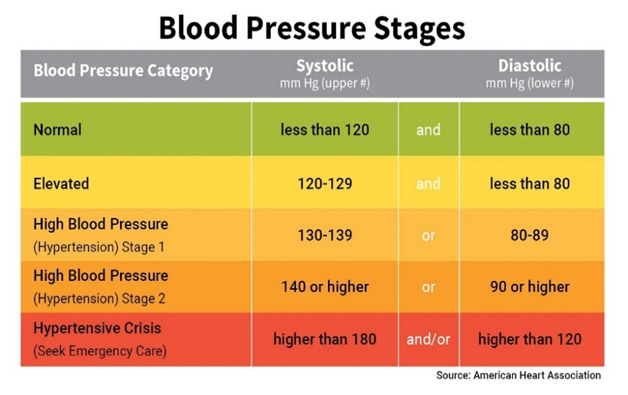
    I took my blood pressure, and that was also pretty good, averaging 130/89 with my final seated test just 125/88.

    My diastolic was still a little high, but still very good for me, and the systolic reading was just about as good as I can expect.

    American Heart Association image displaying blood pressure stages from normal through to hypertensive crisis.

    But even more important for me is my standing blood pressure, which was 116/83. That’s a drop of just 9 points systolic and 5 points diastolic, which is well within the healthy range for a standing drop. You may recall I have seen drops as high as 30 points and even more of systolic pressure, which comes with a very high risk of fainting!

    All in all, I’m very happy with my week so far, and excited to get back to fasting and seeing some more weight loss. Obviously, this weekend’s Chinese meal will have represented a small blip in my weight loss, but one I’m very happy with. I know a couple of 36-hour fasts and my usual keto diet will see me reverse that blip and get back on track in no time!


    , , , , ,

  • I don’t believe in karma. But now and then, it does feel a little bit like there’s a malicious and/or mischievous fate determined to kick us just when we are at our best.

    And at other times, it feels like things are always darkest before the dawn, and new hope arises from the ashes of despair.

    These last two weeks, I can really relate.

    Two weeks ago today, I got the news that I had been selected for redundancy. No, I don’t work for Oracle, but my company, also a global software company, made 4% of its workforce redundant overnight – ostensibly for similar reasons – a major refocus on AI projects. There is clearly a sense that AI can/will make the company more efficient and that these 880 individuals won’t be missed. Of course, they are wrong. I have specialist knowledge that literally a handful of people in my industry share, which AI can never replace, and at a time when my industry is undergoing a historically unprecedented boom!

    But that never stops corporate bean-counters from doing their thing.

    Anyway, I was due the following Friday (March 27th) to have my quarterly diabetic checkup with my GP, and I was still very excited to hear how well I had done over the preceding 3 months in terms of my blood glucose levels – my HbA1C results. However, on Thursday, I received an automated reschedule notification, pushing it out 6 weeks to early May! Annoying!

    Undeterred by this news and my impending redundancy, I decided to pay for a private test from MonitorMyHealth and sent away a blood sample on Monday, getting the results on Wednesday. The results were frankly incredible, beyond my wildest expectations – I had effectively reached type 2 diabetes remission in just 100 days, going from an HbA1c measurement of 79 mmol/mol (9.4%) to 42 mmol/mol (6%)! Here in the UK that is the borderline between “normal” blood sugar and “prediabetes”.

    It was by any measure a simply fantastic result. And I was looking forward to celebrating over the weekend, as I was due to go to a wedding on Good Friday up in Newcastle, and with that result, I might even have allowed myself a slice of actual wedding cake! 🍰

    But by Thursday evening, I was sick as a dog – a cough, mild flu symptoms, but worst of all, at the same time, an awful gastrointestinal bug that had me never straying too far away from the nearest bathroom.

    While I’d joked on Wednesday about my results representing my own personal Easter rebirth, my Easter weekend was in fact ruined. There was no way I could risk driving for 3.5 hours, or, of course, risk infecting fellow wedding guests with the flu. Or risk an accident on the dance floor, for that matter!

    I was sick all over the Easter period – and still poorly today, Easter Monday.

    For obvious reasons, I haven’t been able to do any fasting or exercise during this time. But one thought did occur to me, given the many, many, many trips I had made to the bathroom – sometimes only barely making it in time – surely I must have lost some weight at least? 😂

    So this morning I weighed in to find that all of those dark clouds did indeed have a silver lining…

    Progress Update • Week 15 – April 6, 2026 (from December 20th)

    15st 13.6lbs
    223.6 lbs | 101.6kg
    Total Loss: 2st 6.3lbs (34.3 lbs / 15.6 kg)

    Exercise status: Illness stopped play!

    Fasting Status: Illness stopped play!

    Target: 12st 12lbs (180lbs) | Remaining: 43.6 lbs

    Yes, those days of illness have catapulted me to a stonking weight loss week of over 5lbs again, bringing my weight down to under 16 stone! I’m now into the 15 stone range, albeit only just. But I’ll take it! I’m not proud!😂

    Also, that takes me to over 15kgs lost since December and 19kgs in total since diagnosis – this is the target weight loss I was aiming for as it’s one of the clinical recommendations for achieving type 2 diabetes remission. It also means I’ve now lost 15.78% of my starting body weight, with 10-15% of body weight being one of the other clinical recommendations.

    And this now brings me shockingly close to another major weight loss milestone for me – at 101.6kgs I’m only 1.7kg away from hitting double figures in the metric system! 99kg!!!!

    Yes, of course, I know this is mostly water weight (boy do I ever know!!), and there is a distinct possibility that I might see this fluctuate back upwards once I’m fully recovered, but I’ll take every victory I can get right now! 😂🤣

    But also, every silver lining has its own cloud, and this is no different. Given the somewhat extreme illness-assisted weight loss this week, it should come as no great surprise to note that my blood pressure has also reduced. We know that dehydration, as caused by gastrointestinal issues like mine, results in low blood volume, which equates to low blood pressure.

    This morning, my seated blood pressure results look almost “textbook perfect”: 116/80.

    But given my ongoing hypertension, this just reflects how low my blood volume is. And we can demonstrate by looking at my standing blood pressure. It dropped from 116/80 with a heart rate of 74 bpm to an all-time low reading of 83/59, with my heart rate racing to 90bpm!

    Low blood pressure – or hypotension – is any reading below 90/60. Not only is my systolic reading low at 83, but my diastolic also just fell under the 60 mark at 59!

    The subjective evidence was equally compelling – this is the first time ever when taking my standing reading where I’ve actually had to sit down to avoid the risk of fainting. So that 83/59 is actually after I’d taken a minute to sit back down, then got back up again. It must have hit lower than that at least for a moment.

    Don’t worry, I’m used to the occasional light-headedness and have trained myself instinctively to sit down any time I have even the slightest feeling of dizziness, as I did today. It’s always better to be safe than sorry.

    To rehydrate, I’ve already doubled up on my regular electrolyte tablets, and added a healthy dose of salt to my water, along with a further soluble High 5 electrolyte tablet! I’ll also be very liberal with the salt on anything I eat today – illnesses, especially gastrointestinal ones, can really hit your hydration levels hard and counter-intuitively, while salt is generally described as “the enemy” for people with hypertension, when your blood pressure drops like mine has done suddenly it is your best friend.


    , , , ,

  • So, you miraculously reached type 2 diabetes remission in just 100 days! Yay! Let’s celebrate! But isn’t that it now? You’re done, right?

    No, of course not! Firstly, true diabetic remission is measured by getting your HbA1c result to 48mmol/mol and keeping it at or under that level for 6 months. So even if there was nothing else to do but maintain, I’d still be here talking about it.

    But as you’ll know if you’re a long time follower, or just happened to read yesterday’s recap post where I asked the somewhat tongue-in-cheek question “why did it take me so long?”, you will know that one of the reasons I didn’t address my diabetes sooner was that I got hit with the common double-whammy comorbidity – diabetes is often joined by hypertension. And my blood pressure skyrocketed to as high as 206/112 – which is classed as “hypertensive crisis!”

    It’s at this point that you are at severe risk of either a stroke or a cardiac incident.

    While diabetes is a slow, insidious disease, where high glucose levels in your blood gradually damage and ultimately kill off your nerves, starting with your extremities (feet, then hands) as well as your retinal nerves, leading to blindness, loss of feeling and related complications, hypertension is called “the silent killer”. Often presenting no symptoms at all (as in my case) until it’s too late and you have a stroke or heart attack, which of course can be fatal.

    I had to stop exercising and fasting because both can increase blood pressure, something I simply couldn’t afford to risk.

    You may also have seen me talk about how I was able to halve my blood pressure medication as a result of losing so much weight – I reached a point where I was over-medicated and experiencing low blood pressure and even fainting episodes.

    But since halving my meds, my blood pressure has still been somewhat erratic. While nowhere near as bad as it was at the outset, I’ve still had days like this last Tuesday where my first reading was 160/102! I always take three readings in a row as often the first one is high – it takes a while to just relax into it. But my second and third readings on Tuesday were 150/96 and 155/93 which puts all of the readings in the “stage 2 hypertension” category – one step down from “hypertensive crisis”.

    Shouldn’t I go to the doctor with such high readings? Not necessarily. My previousl readings a couple of days before were 140/90, 136/89, and 136/88 which is “stage 1 hypertension”. It’s not unusual for people adjusting their medication to see such big changes as your body has to adapt to less support from medication.

    This week I’ve been fighting off a really bad cold / flu virus, and today I’m feeling much better – so this morning’s readings of 144/93, 140/89, and 139/87 weren’t actually that bad. Many illnesses can result in spiked blood pressure, since they provoke a ‘stress response’ in the body, releasing adrenaline and cortisol, which naturally constrict blood vessels and raise heart rate. My elevated seated readings today are likely my body still being in ‘defense mode’ from the virus.

    I do watch these changes closely, especially if I’m stressed or ill. If I had a few days in a row of stage 2 hypertension I would definitely talk to my doctor – it’s feasible that even though I’ve made an incredible transformation, losing 30lbs (14kg), and achieving type 2 diabetes remission, the cuts we made to my medication might have been a step too far. I might still need to adjust my medication again.

    The biggest reason that I am reluctant to increase my dosage again is that there is a flip side to the coin of BP medication. These medications reduce your blood pressure, and I’ve now had two separate instances where low blood pressure has resulted in my fainting – both times linked to what is called “cough syncope” when I’ve had a cold/flu and coughed so hard I literally passed out.

    As well as taking my seated blood pressure, I am also in the habit of taking my standing blood pressure – so after my three seated readings, I then stand up and almost immediately take my BP again. At this point, we are watching for the “standing drop”. While you are seated and relaxed, your body naturally needs to maintain less “hydraulic pressure” in the system. When you stand up, the blood vessels, especially in the lower body, tighten up to maintain a healthy level of pressure. If you’ve ever experienced mild lightheadedness when standing up, this is because your vascular system isn’t able to respond to the change in position quickly enough. This is called “orthostatic hypotension” (note – hypo not hyper!) and can be quite dangerous – if your system doesn’t respond appropriately, you can simply faint, which from a standing position can be very dangerous.

    Orthostatic hypotension is classed as a drop of 20 points of systolic pressure (the first reading), or 10 points of diastolic pressure (the second reading). Today, mine dropped 52 systolic points and 17 diastolic points!

    While my seated BP wasn’t too bad, my standing drop was atrocious! I went from 139/87 to 87/70! If my starting blood pressure had in fact been “healthy”, let’s say 120/80, I would almost certainly risk a fainting episode.

    Being on blood pressure medication is, therefore, a bit of a double-edged sword, since part of the effect of these medications is to relax your vascular system, but a relaxed vascular system is what leads to orthostatic drops.

    So as long as my BP is not dangerously high (which I class as two days of concurrent stage 2 readings), I will just let it ride and keep monitoring. Every week that goes by, as I continue to exercise, fast and eat more healthily, my need for medication to support my blood pressure should reduce.

    The plumbing vs the fuel

    The main thing is that by removing the diabetes from the equation I’m helping my blood pressure hugely – there are very good reasons the two conditions are often diagnosed together. But the thing to remember is that type 2 diabetes is caused by putting the wrong fuel in your engine. Too rich a fuel in terms of glucose is not good and casues harm (nerve damage) – but it’s “easily” fixed. Change the fuel, and you very quickly begin to see improvements.

    Hypertension is not a fuel issue, it’s about the plumbing. High blood sugar doesn’t just sit in the blood; over years, it causes systemic inflammation and oxidative stress that physically stiffen the arterial walls (atherosclerosis). It’s this stiffening that makes the engine less responsive. At the same time, type 2 diabetes is often (although not always) associated with obesity. As you increase blood sugar, you put on weight, and this excess weight requires further adaptations from your plumbing.

    Studies show that a 1kg drop in body weight can be typially equated to a 1 point drop in systolic pressure. I’ve actually seen well inexcess of a 60 point drop from my initial crisis readings. Why is this? Because I haven’t simply lost weight. And this is really important. Yes, weight loss is important because carrying excess weight makes the body work harder every minute of the day, which increases blood pressure. But you HAVE TO CHANGE THE FUEL.

    You CAN lose weight just by cutting down on the amount of fuel you put in the engine, but if you’re still using the wrong fuel then you will only see minimal benefits.

    Exercise is also important. By using the machine regularly and more intesively, it automatically becomes more efficient and effective. You are not only changing the fuel, and shrinking the plumbing, but you are increasing its overall efficiency. This is why I’ve seen such a huge transformation in my health.

    Changing the fuel is the quickest and easiest thing you can do for yourself, but if you want to change the plumbing then it will take time.

    I still have my delayed diabetic check up in a months time, on 5th May, and I’ll be very excitedly showing them my MonitorMyHealth HbA1c test results. But I also always go armed with my blood pressure spreadsheet, and this will paint a more grounded picture, showing that my health transformation isn’t over yet. I’ve come a long way, and reducing my blood pressure medication is a huge step, but there’s still work to be done.


    , , ,

  • Why did it take me so long?

    ·

    If you read yesterday’s post, you’ll have seen I hit an absolutely massive milestone in record time. I’ve effectively reversed my type 2 diabetes!

    I went from a glycated blood sugar reading of 79mmol/mol in December 2025 to just 42 mmol/mol yesterday! Just 100 days, slightly over 14 weeks.

    So what do you mean, “why did it take me so long?!” That’s incredible!

    But you have to remember that I was originally diagnosed with Type 2 Diabetes in July 2023 – which is 2.5 years ago now!

    The initial (double) diagnosis

    I was exhausted all the time and didn’t know why. I’d beaten testicular cancer almost a decade earlier, and my initial thought was that it was low testosterone, a common enough issue in men in their 50’s. But bizarrely, my endocrinologist found that my testosterone, while a bit low, was well within “normal/healthy” bounds.

    It was while investigating that exhaustion that we found my diabetes. And being the data-driven person I am, I did my homework and knew what the risks associated with Type 2 Diabetes could be. Fatigue is definitely one of symptoms. Diabetes makes your body work so much harder just to keep going. The human body is an incredible machine, but it can only take so much before something starts to give.

    I restarted this blog at that time – on July 6th, 2023 – and even quoted this:

    Untreated diabetes affects many major organs, including your heart, blood vessels, nerves, eyes and kidneys. Diabetes UK

    On July 8th 2023 in a post titled “Shit got really, really real!” I talked about the link between diabetes and pancreatic cancer – the insidious cancer that took my dad’s life when he was younger than I was at that point, just 53 years old.

    I was clearly motivated at that point – and lost 4.6lbs by the next weigh-in, started up my walk-run program, and was doing 36-hour fasts. But then something happened. I’m piecing it together by reviewing my blogs at the time, and what happened was I was diagnosed with chronic hypertension! My first reading was 180/108 – which is “hypertensive crisis!”

    I was messed around by the NHS, but when I was finally seen by someone, partly expecting to discover that my home BP monitor cuff was wrong, but on their whizzy digital cuff, my BP came in at 206/112!! So I had to put everything else on hold while I dealt with this second, more imminent health crisis.

    Just for context, “hypertensive crisis” readings are the point at which there is a fair chance of either stroke or a cardiac incident! At one point, my reading was as high as 201/128, with a headache and tingling in my fingers! I was, of course, stressing out about all of this, which didn’t help at all. I ended up taking a few weeks off work due to the stress, as I simply couldn’t focus at all.

    I was immediately prescribed Losartan – just 25mg – which barely made a dent. It took some months of back-and-forth, an increase to 100mg, as well as two more prescriptions, before my blood pressure began to get back towards normal.

    In fact, it wasn’t until February 2024 that my BP readings started to look consistently safe – 112/85, for example – still slightly elevated systolic pressure, but my diastolic was back to normal. I was told that once diagnosed with hypertension, slightly high readings would almost always be expected.

    So I had put everything on hold while I dealt with this second, more imminent health crisis. I didn’t put weight on at this point, as I was being careful about what I was eating – reducing salt mainly – but I also wasn’t losing weight.

    My diabetes seemed to have stabilised – I was hovering between around 52 and 57 mmol/mol – so about 4-9 points above the diabetic threshold of 48 mmol/mol – so it just seemed like a much less pressing issue at that stage.

    I’m sure many of those who suffer with type 2 diabetes are aware that hypertension and T2D are often bedfellows. The increased insulin released to deal with high blood sugar often causes the kidneys to retain salt, which in turn leads to hypertension.

    And it’s worth mentioning that one of the symptoms of hypertension is also fatigue. It’s a real double whammy, and no wonder I was struggling.

    What were the root causes?

    There were a few factors leading to my double-diagnosis of type 2 diabetes and hypertension – the most obvious was dealing with my dog Willow’s chronic illness. She had been diagnosed with and treated for cancer the year before, and it came back. This time, I missed the signs, and it was too late. Despite months of vet treatments – and vet bills, which exceeded the coverage my insurance offered – I ultimately had to let her go. It was heartbreaking as she was my baby. She was 12 years old, which for a German Shepherd is, sadly, not unusual.

    While I was caring for her, the thought of cooking healthy meals went out the window – it just seemed like another chore, and I often relied on takeouts.

    One of the other causes of my stress at that point was my finances – not just Willow’s vet bills, but I hadn’t been paying attention to the increasing mortgage interest rates, and I was on a variable rate. Before I knew it my mortgage payments spiralled from around £1,800 per month to £2,800! I simply couldn’t afford my house anymore at that level. So, I started a 9-month project to find a new house and sell my own – there was work that I had to do to my home before I could even market it, which saw me relying on my credit cards since Willow’s treatment had chewed through my savings, and my mortgage ate up all of my disposable income. I was in crisis mode.

    A new home and a new start…and new stresses and diagnoses!

    I literally just closed on my new house in August 2024, right before I maxed out the very last of my credit cards. Another month and I would have been in serious financial trouble.

    It’s no surprise that during that time I was reverting to eating takeouts even though they were adding to my financial burden, as well as hurting my health.

    Even after I moved house, my money worries didn’t end. There was work that needed doing to the new house. The former owners had hidden a number of things that I should have looked into more closely. I’d only taken a house buyer survey, and not a full survey, and this didn’t cover everything.

    So 2025 started with more issues to deal with. More stress. More costs. And I was relying on takeout again.

    2025 was also a busy and stressful year at work as I was piled with more responsibilities. The summer came around, and it was in June 2025 that I was suddenly diagnosed with shingles! At first, I thought it was just a regular flu, but it was way worse. I was coughing so hard I wound up fainting. Syncopic coughing is the technical term. What happens is, as you cough, you can’t breathe in, and as a result, your blood pressure drops. For normal people, their vascular system is flexible and resilient enough that it’s not a problem, but when you are on medication that artificially lowers your blood pressure, while also reducing your vascular responsiveness, you can literally cough yourself unconscious. I did. Twice.

    The first time, in a panic, I sat up on the edge of the bed during my extreme coughing, which of course also lowered my blood pressure further, and like that I was gone. The next thing I knew I was lying on the floor with my partner anxiously hovering over me while dialling the emergency services number at the same time!

    Fortunately, shingles is very easy to treat with a simple anti-viral, and I quickly learned to sit the heck down as soon as any sign of coughing began! 😂

    It still took me a few weeks to recover, and that pretty much brings us back to where I restarted this blog, in December 2025, after my first actual symptoms of diabetic neuropathy. It was only at that point that I discovered my “stable” blood sugar had skyrocketed from 59 mmol/mol to 79mmol/mol.

    I’ve said it before, and I’ll say it again – “life gets in the way”. And sometimes it seems to do so quite aggressively.

    A serious of unfortunate events

    It all sounds absolutely horrendous in hindsight! I was literally prevented from exercising and fasting by my hypertension for the best part of six months, and after that, I was dealing with another stress and then another. I was moving from one crisis to another, with work stress, financial stress, and health crises.

    It wasn’t until my diabetes became the biggest, most urgent crisis that I committed to taking drastic action.

    And obviously I’m glad I did. Equally, I do wish I’d started earlier, but in hindsight, it’s hard to see when and how I could have started with everything else I was dealing with.

    So what’s the point of this post?

    The moral for me is – don’t give up. Definitely don’t give up hope. As hard as it seems, you can repair your health! And in the process of reversing my type 2 diabetes, I’ve already halved my blood pressure medication, which is a huge step forward. I’m not finished yet, but I know I have the tools necessary to get the rest of the job done.

    But go easy on yourself! If life gets in the way – let it. Don’t beat yourself up because you don’t have the time, energy or emotional bandwidth to focus on your health.

    As I mentioned, the first symptom I had of my diabetes and hypertension was fatigue. It’s really hard to do anything when you constantly feel tired. If you are feeling like that, then I feel your pain!

    But it doesn’t have to be hard – there are a few key habits that you need to change, and you will get there. Maybe not in 100 days, but if I can do it in under 4 months, maybe you can do it in 6 months. Or 9 months. Even if you did it in a year, wouldn’t that still be an amazing achievement? To turn around your health to the point where you significantly reduce your risk of nerve damage, heart attacks, or strokes?

    And I can tell you that one of the first changes I began to see after I started my aggressive protocol was that my fatigue began to lift. It was slow at first, sure, but now it’s almost entirely gone. I won’t say I feel 20 again, but I have no issue getting up to go for a swim or a run, where I might initially have dreaded it and had to really push myself. I can walk up stairs without getting out of breath. Which is great because I moved into a three-story townhouse! 😂

    So start small if you have to, but know that you can do it. If you make some changes and you stick with them, you too can turn your health around.

    You’ve got this! If I can do it, even despite all of the obstacles I found in my way, then you can too!


    , , ,

  • As you will know if you’ve been following my blog lately, I recently sent off some blood to MonitorMyHealth for a new HbA1c test. Normally, of course, I would get my HbA1c free of charge through my GP, but they rescheduled my quarterly check-up from last Friday (27th March) to early May. I had really been looking forward to seeing how much of a change there had been in my blood sugar after all my hard work over the last three months.

    So I decided to go the private route – and paid for a MonitorMyHealth HbA1c test. MonitorMyHealth is an NHS partner and uses NHS labs for their tests, ensuring the results are reliable and consistent with my usual tests.

    And the results are now in!

    And they may shock you.

    They did me.

    Can you bear the suspense?

    OK – drum roll please…

    Graph showing HbA1c blood sugar test results over a period of approximately one year months, starting at 59mmol/mol in April 2025, rising to 79 mmol/mol in December 2025 and then sharply declining to 42mmol/mol in March 2026

    Wait I hear you cry – does that really say what I think it says??!!??

    Did you really just hit 42 mmol/mol after 14 weeks!?!?

    Yes, dear reader, it’s true! 42!

    According to Douglas Adams – that’s the meaning of life!! 😝🤪 And for me, as a type 2 diabetic seeking diabetic remission, it really is the magic number! The answer to life, the universe, and everything is 42! It all makes sense now!🤣😂

    You’ve no doubt gotten bored over the last few posts of me speculating on what my results might be. I had told you (many times!) that I wouldn’t be unhappy if I made it to under 60. As you can see from the graph above my previous test before December was back in March 2025, and I was at 59mmol/mol. At that point, diabetes didn’t feel urgent to me at all. I had no real symptoms other than my high blood pressure (we’ll come back to this in a later post!), so I didn’t take any action back then. So in my heart of hearts, I knew that I would accept a return to 59 or lower as a huge success. It took me 9 months to get from 59 to 79 so getting back to 59 in 3 months or so would have been a real achievement.

    But I do like a good challenge – and I was quietly confident that I’d go beyond that. That I would even reach the “low 50’s”. But secretly, I was hoping to hit 48 mmol/mol. That’s the red line on the graph there, and that represents the barrier between “diabetic” (48 and above) and “prediabetic” (42-47).

    Let me restate this so we’re clear – hitting 48 mmol/mol after a diabetes diagnosis, and retaining it for 6 months without medication, is considered to be “diabetic remission”. Since I’ve never taken diabetic medication – despite my GP pushing me for some time to consider Metformin – I only needed to hit 48mmol/mol and retain at that level or under for another 6 months and I would be in diabetic remission.

    But I didn’t hit 48. I hit 42!! 42!!! Let me say it again for those in the back – 42 mmol/mol!!!!!

    42 was my next target – after I hit 48 this time – or very near to it, I was going to set my sights on 42!

    And I’ve hit it straight off the bat after just 14 weeks. That’s 14 weeks and 2 days to be exact.

    But here’s another magic number for you – it’s 100 days exactly from my last test results on 23rd December to my new results which came in today!!!

    100 days to diabetic remission!

    I’m no longer technically diabetic! I am now just on the border of prediabetic!!! And literally only just!!! Describing me as prediabetic is really being very conservative and while it’s factually accurate, the reality is that I’m not stopping now. I still have more weight to lose, and still have hypertension / high blood pressure to address by losing weight and increasing my fitness. So I will certainly breeze through from 42 to well under 42.

    I still have my follow-up diabetic check-in due on May 5th, and by then, I am 100% certain that I will be “normal”. No question about that whatsoever.

    Easter is, of course, symbolically a time for renewal and rebirth, so it’s also incredibly fortuitous timing with Good Friday tomorrow. I literally feel like I’ve been born again! I’m sure you can probably imagine that I’m literally quivering with excitement today. This is everything I’d worked for and more than I’d hoped to achieve in such a short space of time.

    But most importantly it’s a message of hope for other type 2 diabetes sufferers.

    Often, doctors give the impression that this is a lifelong condition that is a long haul to combat. I’ve just demonstrated that it doesn’t have to be that way. Even after being diagnosed over two and a half years ago (July 3rd 2023), it is possible to reach remission in a matter of weeks! 100 days!

    Of course, you don’t have to attack your diabetes quite as aggressively as I did. In many ways, I was ideally positioned to defeat diabetes. In the past I’d lost weight and improved my health on separate occasions through ketogenic diets (50lbs in 6 months), through intermittent fasting (60 lbs in about 9 months), and through exercise (70lbs in around a year).

    I knew that individually, each of these approaches worked for me and could achieve great results. My thesis, which I’ve now proved beyond any doubt, is that by combining all three, I could effectively achieve remission for my diabetes in record time.

    And here we are, 14 weeks / 100 days is all it took.

    And as you’ve seen if you read my blog…that wasn’t 100 days of pure denial and pain. I found new snacks to make eating strict keto more enjoyable, including regularly eating my favourites for breakfast like bacon and sausages. I discovered a keto chocolate mousse to replace a more expensive shop-bought supposedly high-protein dessert, and made keto-friendly tacos.

    I had blips and slip-ups – including a Christmas period where I allowed myself to fall off the wagon entirely and ate three Christmas dinners, with wine, and desserts! I allowed myself those little blips because I was so confident in my plan. I was easy on myself when I got ill and couldn’t fast or exercise. All it took was confidence in the plan, patience and persistence.

    And here I am! I hit what is probably the single biggest target of this entire journey, and way ahead of schedule. 42 mmol/mol in 100 days from 79! It’s a legendary result and I couldn’t be happier. This journey started, as you may recall with a wake-up call on a business trip where I experienced my first symptoms of diabetic neuropathy – pain in my foot that lasted 18 hours. I immediately started making changes as a result of that one fearful night, and since then, my symptoms have been minimal – the odd tingle and numbness lasting a few minutes, nothing more.

    I’ve now reached a point where I’m no longer diabetic, which means no more nerve damage! I’m done with that problem entirely. I mentioned I’d been diagnosed with the very earliest stage of diabetic retinopathy – which can lead to blindness – that disease is effectively stopped dead in its tracks now. No more damage, and my nerves have the time they need to recover. It’s literally a life-changing transformation. Potentially a life-saving transformation.

    Anyway – on that happy note, I’m signing off for now, to bask in my success! 🥰

    Wishing you all a fantastic Easter – I hope this festive weekend brings you the rebirth you dream of too!


    , , ,

  • The suspense is killing me!

    ·

    I just had an email notification from MonitorMyHealth, where I sent my blood on Monday for a new HbA1c test – they have confirmed receipt of my sample, which now means it’s just a matter of time before I get my results!

    Hopefully by tomorrow I will know for sure how successful I’ve been in reaching remission for my type 2 diabetes.

    A huge deal for me, it’s what I’ve been working so hard for for the last 14 weeks, and I’m really excited to see just how far I’ve come.

    I’m very confident I’ll make it into the 50s (mmol/mol), and really think I’ve done enough to get towards the low 50s.

    Anything under 55 mmol/mol would be a spectacular result from my last test in late December at 79mmol/mol.

    But secretly in my heart of hearts I’m hoping for a truly earth-shattering result – 48 mmol/mol or less! That is right at the very edge of what is conceivable based on everything I know about how lifestyle changes can affect your blood sugar.

    As you’ve seen in my blog, I took very drastic steps, not only changing my diet completely to a ketogenic and dash friendly diet, cutting out all bread, all pasta, all potatoes, all rice, not only cutting out obvious sugars but even restricting fruit intake to berries which are among the lowest sugar options.

    And on top of that I have fasted regularly for 36 hours three times a week, not quite every week, I had a few gaps, but most weeks. Intermittent fasting has been proven to be one of the most effective treatments for type 2 diabetes, and alternate day fasting with 36 hour fasts is a highly aggressive and effective protocol, giving your body plenty of time to burn out all the glucose stored.

    And obviously while you’re fasting your blood sugar is completely stable with no spikes whatsoever giving your system a chance to fully recover.

    And finally to top that off I’ve been exercising 4 to 5 days a week, alternating swimming (1km-1.5km) with running (only walk run intervals, but still, given my body weight this is still huge).

    Exercise of course will also help clear out any glucose and ensure I’m quickly switching to fat burning mode.

    At the same time I’ve lost just shy of 30lbs (13.8kg), which is precisely the figure quoted by the most reputable studies of diabetics at which diabetic remission is typically seen.

    Diabetic remission is generally measured in the UK as reaching 48 mmol/mol and maintaining that reading or lower for at least 6 months without medication.

    As you also know I have never taken medication for my diabetes, only some for my hypertension, And as you’ve also seen, I’ve changed my body so much in the last 14 weeks that just a month ago I had to halve my meds.

    All of this tells me that if anyone can possibly achieve a full remission in 14 weeks, then it should be me! 🫣

    Of course, I am hoping for the best, but preparing for the worst, I know that major body changes take time, I know that even making such radical changes to habits can take a while to register.

    In my mind the worst case is anything over 60 mmol/mol. But that certainly won’t deter me from continuing what I’m doing, it will just tell me that this is going to take 6 months rather than the 3 months I’d originally anticipated.

    It took me over 9 months of bad habits to get from 59 mmol/mol to 79 mmol/mol, so reversing that in 6 months would still be no small achievement.

    And that’s not forget, they’re even once I get to my target – and my ultimate target is 42 mmol/mol which is classed as “normal” or healthy – I will still have to maintain some elements of my lifestyle changes for the rest of my life.

    Being type 2 diabetic means I have genuine insulin sensitivity issues, and those will not go away just because I get back to normal. I have demonstrated that I have a susceptibility to diabetes, and it’s something I’ll have to always be aware of.

    Switching from aggressive protocols to reach my target to more moderate approaches for maintenance will be a whole new journey for me.

    But unlike previous occasions when I have lost significant amounts of weight – ranging from 50 to 70 lbs – this time I have a much stronger motivation to not let myself slip back into old habits.

    What started this journey was my first symptoms of diabetic neuropathy, and I have since been diagnosed with early stage diabetic retinopathy.

    I am not about to risk my nerves getting any worse by letting sugar get the better of me again.

    I’ve heard so many horror stories of people being literally crippled by their diabetes and that is not going to be me.

    Anyway, just a little rant to while away the time while I wait for my results!! 😊