

As I mentioned in a previous post, I recently got my first continuous glucose monitor (CGM), and was a little confused by some of the readings. My confusion has persisted over the last few days, as I’ve watched my blood sugar go up above the “safe/healthy” threshold of 5.5 mmol/L (99mg/dL) even while fasting for 36 hours.
The “dawn phenomenon” is well known while fasting or on a ketogenic diet – in the morning, your liver will produce glucose naturally to provide sufficient energy for the day, and mine has regularly taken me up to 6.0 mmol/L (108mg/dL) and even as high as 7 mmol/L (126 mg/dL)!
But I was seeing high numbers throughout the day, fairly randomly. Or so it seemed.
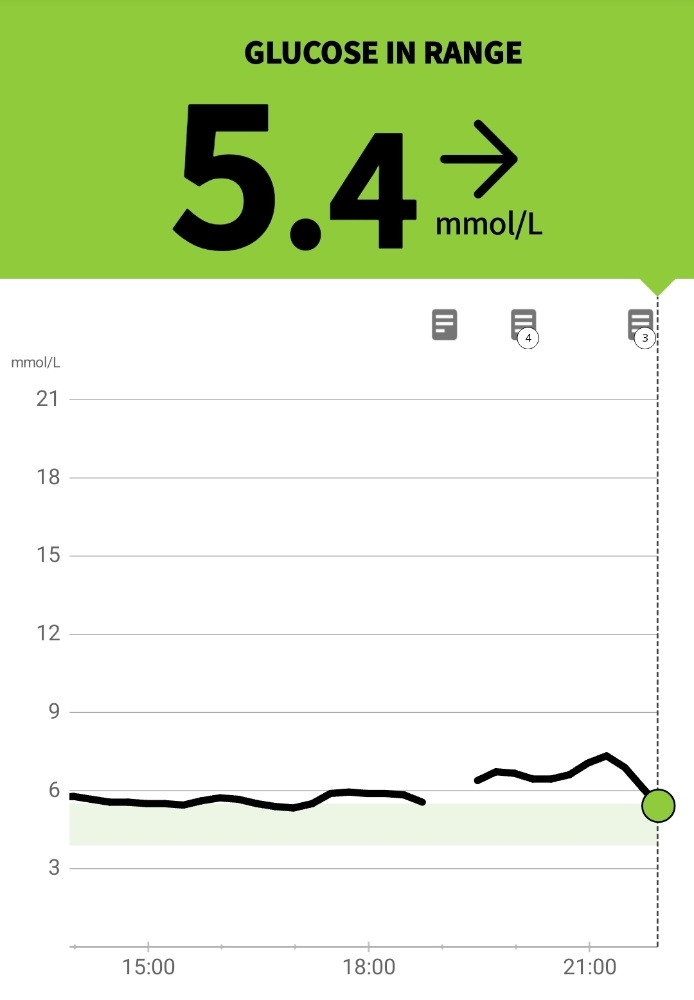
Then yesterday I had a revelation. I had been fasting for around 22 hours. Before breaking my fast, I went out for a run – if you look at the output from my CGM to the right, you can see my run is where the broken line on the graph sits, near 7 pm. Since I don’t take my phone with me when I run, there were no updates during that period, hence the broken line.
Before my run, despite being fasted for about 16 hours, my blood sugar was hovering just above the green line, which is 5.5 (99).
When I came back from my run my blood sugar spiked! It went up! It was 6.2 when I got home, but within 30-40 mins it was up to 7.3!!
I was genuinely upset! During exercise, surely you should be using up what glucose there is in your bloodstream? It should go down! Right?!
Anyway, I had decided to mix up my routine, and instead of my usual 36hr fast, the plan was to break my fast around 22 hours.
So, I broke my fast with a nice keto-friendly omelette with mushrooms, red onion and spinach, some grated vintage cheddar, plus my usual nitrate-free bacon and two 95% meat sausages.
Immediately, my blood sugar started to drop! And it continued to do so until it reached around 5.1!
How is this possible? It’s totally paradoxical that blood sugar should RISE during exercise and FALL after eating! It’s completely back to front, isn’t it?
But then I did some reading and what I found was a huge revelation.
The “Run” Spike (Glucose Dump)
When I went out for my run while 16 hours fasted, my body recognized a sudden, massive demand for energy.
- The Mechanism: My liver isn’t going to wait for me to eat; it “buffered” the system by dumping stored glucose into my bloodstream to ensure my muscles didn’t fail during my run.
- The “Lag”: The spike continued after I got home because my adrenaline and cortisol (stress hormones from the run) were still telling the liver to “keep the fuel coming” even though the physical demand had stopped. That jump to 7.3 was my body overcompensating for the workout.
The “Omelette” Drop (The Insulin Pulse)
This is the most fascinating part of the graph. I ate a significant meal, and my blood sugar actually dropped!
- The Mechanism: Even though the meal was ultra-low carb (strict keto), the protein in the eggs, bacon, and sausages triggered a small, healthy Phase 1 insulin response! It’s the only rational explanation.
- The Result: That small pulse of insulin was enough to tell my liver, “Okay, we have external fuel now, you can stop the emergency glucose dump.” The insulin cleared the “exercise glucose” out of my blood and moved it into my cells, causing the numbers to dive back toward the green zone.
The “5.4” Baseline
The 5.4 you see on my screenshot, after 22hrs fasting, then running, and then eating a healthy keto meal is telling. This puts me squarely back in the “healthy/safe” zone between 4.6 and 5.5 (83 and 99). This suggests my “baseline” is actually very healthy.
The “high” numbers I saw earlier weren’t because of what I ate, but because of how well fat adapted I am. Almost too well, since my body was able to pump out far more glucose than I actually needed.
And why did my meal bring it back down to a healthy level? Again, the only reasonable explanation is that my body released insulin to deal with the omelette. Not just a flood of insulin – exactly the right amount of insulin to bring me back to the normal/healthy zone!
This is exactly how insulin normally works in healthy non-diabetic individuals!
I have to tell you, when I realised that I literally welled up with tears. It was incredibly emotional! I’m not as broken as I thought! While of course, I am still very much diabetic, I do have a surprisingly healthy insulin response.
Diabetes is generally considered a chronic and progressive disease, but it really depends on a lot of factors as to exactly how “bad” it gets. High blood sugar does a lot of damage – and it’s a vicious cycle since part of the damage is to your pancreas, whose responsibility it is to release insulin to control blood sugar spikes.
The constant release of insulin required to deal with very high levels of sugar in your blood leads to the beta cells (insulin-producing) in your pancreas becoming exhausted, and either going dormant or completely dying.
For many, by the time they come to treat their diabetes, it’s too late, and permanent damage has been done to their beta cells. Even a very strict low-carb diet may not be enough at that point, often requiring a dependence on artificial insulin.
But what my apparently bizarre CGM numbers have shown me is that my pancreas is doing great! I haven’t completely screwed it after all! It’s a huge relief!
Honestly, it was an emotional revelation. As I’ve also talked about elsewhere, I was on a bit of a downer after seeing my A1c stall at 40, after the initial race from 79 to 42, I thought something was going horribly wrong.
As I said at that time, my CGM should reveal what is really happening and why my A1c didn’t come down further, and now I know. I was reasonably confident I was doing all the right things, but I just didn’t understand the mechanisms properly to understand why my A1C might stall.
Now it makes sense – My fat-adapted metabolism has made my liver very efficient at buffering my blood sugar levels to ensure I always have fuel on board! This “buffering” is keeping my levels high.
So what I’ve learned is that a temporary rise in glucose during a workout isn’t a sign of ‘disease’ – it’s a sign of efficiency. My body was delivering fuel exactly when I asked for it.
The good news is that, again according to my reading, this kind of blood sugar rise from stored fat does not have the same damaging effects as the flood of sugar from dietary sources due to Glycemic Variability. Damage (glycation) happens mostly during big “peaks” and “valleys.” My rise to 7.3 from a run is a smooth, purposeful curve. A rise from my historical “chips ‘n’ dips” or a Domino’s pizza is a violent spike. My body handles the “internal” fuel much more gracefully.
It just means that my goal of getting my A1c down to the late 20’s might be unrealistic given just how well “fat adapted” I am, and my exercise levels.
Another thing I realised while monitoring my CGM is that it’s possible my long 36hr fasts are actually exacerbating this problem, which is why I’m now trying shorter 16-18hr fasts. By giving my body food more regularly, it may be that my highly protective liver will calm down a little bit when I exercise. More news on this experiment over the coming days.
Leave a Reply