

Diabetics are being sold a lie. It’s a lie about “good” carbs and “bad” carbs. We’re told that, if we just switch from white rice to black rice, or from white bread to “multigrain diabetic bread,” we’ve solved the problem.
But for those of us fighting to save our eyesight from retinopathy or our nerves from neuropathy, this isn’t just a white lie – it’s a dangerous distraction.
The biological truth: there is no “essential carb”
In the world of nutrition, there are essential fatty acids (fats) and essential amino acids (proteins). Do you know what there isn’t? An essential carbohydrate.
Your body is a miracle of evolution. Like all mammals, our ancestors survived for millions of years by storing fat and living off it during lean times. The carbohydrates that have become a ‘staple’ of the modern diet simply did not exist back then—no industrial rice, no processed oats, no bread, no pasta.
Even if our ancestors occasionally found a wild tuber, it wasn’t a modern potato. Most tubers were members of the deadly nightshade family – bitter to eat, and literally poisonous unless rendered edible by fire. They were a food of last resort, a survival tactic for when the hunt failed, not a foundational part of our biology.
The biggest ‘sugar hit’ our ancestors would have found was the occasional seasonal fruit or – after risking a swarm of bees – some wild honey.
Instead, we survived by burning our own body fat for fuel. Through a process called gluconeogenesis, your liver creates the exact amount of glucose your brain and red blood cells need from proteins and fats. You don’t need a single gram of external carbohydrates – not one grain of rice or slice of bread – to survive or thrive. We aren’t designed to be fueled by a constant stream of sugar; we are designed to be fat-burning machines.
It’s actually why we store fat so well! We evolved that way as a survival mechanism!
The “better” trap
Manufacturers love to use words like “integral,” “cracked,” and “whole.” They want you to think their product is a save haven for diabetics. And sure, black rice is objectively better than a chemical-laden “diabetic” candy bar made of polydextrose and erythritol. A slice of sprouted-grain bread is better than a donut.
But “better” is a relative term.
- If you’re at the bottom of a hole, a slightly shorter ladder is “better,” but you’re still stuck in the hole.
- If your daily limit is 25g of carbs to keep your blood sugar flat, a “healthy” serving of black rice (34g of carbs!) still bankrupts your budget and spikes your insulin.
The glycemic smoke screen
The “healthy carb” industry relies on the Glycemic Index (GI). They tell you these carbs digest more slowly. That might be true, but for a diabetic, a slow-burning fire still burns the house down. A “slow” spike is still a spike that causes oxidative stress and damage to your microvasculature, leading to hypertension and nerve damage.
When we eat these “healthy” grains, we are still feeding the same addiction. We are still telling our bodies to rely on glucose instead of burning our own fat for fuel, the way we did for millions of years.
The devil is in the details, but what underlies the design?
The devil is always in the details. When you look at the label of that “diabetic-friendly” bread and see 24g of carbs for two slices, the “detail” is the cracked wheat on top, but the “design” is a cleverly marketed starch-delivery system that keeps you dependent.
We have to stop asking, “Is this carb better than that one?” and start asking, “Does this food move me toward healing or toward more medication?”
If you want to achieve lasting remission, you need to fundamentally question your relationship with carbohydrates and the myths you’ve been raised with.
The final betrayal: tearing down the food pyramid
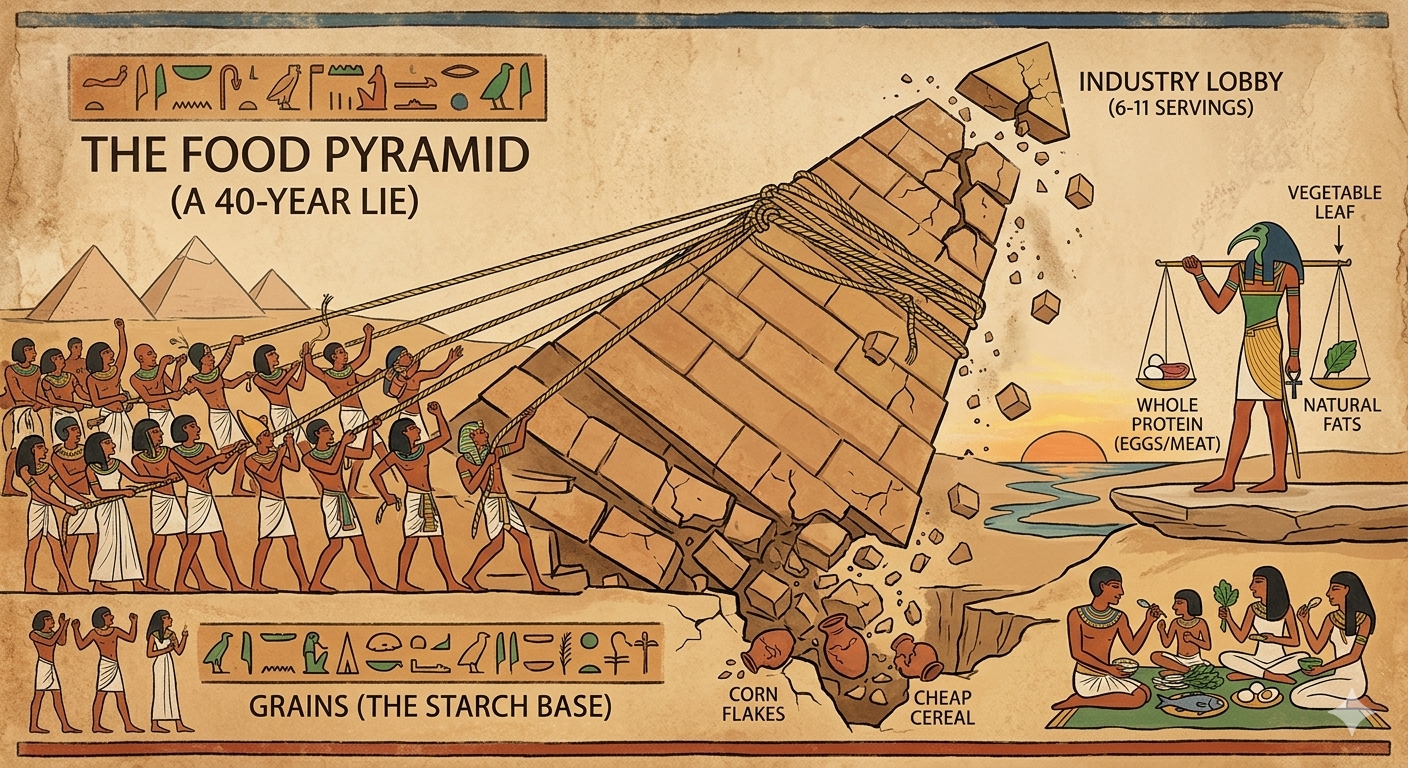
One of the key reasons for this misguided belief in the power of carbs is the traditional “Food Pyramid” that most of us were raised with is a lie. It is the cornerstone of the addiction that breaks us.
Think back to that colorful triangle from school. It told us – with absolute authority – that the “base” of our survival should be 6 to 11 servings of bread, cereal, rice, and pasta every single day. We were taught to build our lives on a foundation of starch. We were told to fear the very proteins and fats that human beings thrived on for millennia.
The pyramid – not a map to health but a blueprint for metabolic disaster.
It took a species designed for strength and resilience and turned us into glucose-dependent addicts. It told us to build our houses on a foundation of sand – specifically, the kind of sand that turns into sugar the second it hits our bloodstream.
For a diabetic, following that pyramid is like trying to put out a fire with gasoline.
The foundation of a damaging lie: who built the pyramid?
To truly walk away from the “Healthy Carb” myth, we have to understand where it came from. Many seem to think the food pyramid came from on high on stone tablets. Or at least that it was designed by doctors to save our lives. The truth is much more cynical.
It was born from a budget, not a lab.
The very first version of the traditional food pyramid was created in Sweden in 1974. It wasn’t a health guide – it was a frugality guide. The goal was to show people how to fill their bellies on a budget during a time of high food prices. Bread and pasta were at the bottom because they were cheap, not because they were healthy.
The American “dream”
When the US version was being developed in the 1980s, the lead nutritionist, Luise Light, actually designed a version with fruits and vegetables at the base. She recommended only 2–3 servings of grains a day.
But the USDA – whose job was and is to sell American crops- stepped in. They overrode the scientists and jacked the grain requirement up to a massive 6–11 servings a day.
Luise Light famously warned that this change would trigger an obesity and diabetes epidemic. She was ignored. Industry profits won; our health lost.
Rebranded animal feed
You’ve heard the term “cereal” your whole life, but at the turn of the last century, these grains were primarily used as animal feed. Industrial milling created a massive surplus of grain byproducts, so the industry got creative. They used the same machines that made “kibble” for livestock to extrude “flakes” for humans. They rebranded low-cost animal filler as a “scientific” breakfast, and we’ve been eating like prize-winning cattle ever since.
The Verdict
The Food Pyramid was never a medical prescription. It was a sales brochure for the grain industry.
For a diabetic, following the Pyramid isn’t “balanced eating” – it’s participating in a 40-year-old marketing campaign that has failed us. It’s time to stop building our health on a foundation of rebranded animal feed.
Trash
It is time to take that food pyramid and throw it into the trash can of history, right alongside other “expert” advice like smoking for relaxation or using leeches to balance the humors.
The new “foundation” doesn’t have a base of grains. It doesn’t have “healthy” black rice or “diabetic” bread holding it up.
- The base should be real, whole proteins and healthy fats. Eggs, cheese, grass-fed meats, and the nutrient-dense vegetables are what keep blood sugar flat and support metabolic health.
- The peak of that pyramid, for me, is the ultimate freedom: Fasting. The realization that I don’t need to be constantly “refueled” by a starch-delivery system. That taking a break from eating – giving our organs a rest and time to recuperate – is just as important to our metabolic health as what we eat.
Once you see the blueprint for what it is – a design for dependency – you can finally stop building a metabolic house of cards and start building your own health, on a stronger foundation. Whole foods, not whole grains. Essential nutrients, not marketing bullshit.
Leave a Reply